
Custom Software for Perth Mining and Resources Companies: Field Data, Fleet and Compliance
Table of Contents
You already know the gap. Your geologists log drill data on paper, then someone keys it into a spreadsheet three days later. Your trucks carry GPS units that don’t talk to your maintenance system. Your safety officer builds incident reports in Excel because the software head office bought never fit how a WA site actually runs.
That’s the gap custom software for Perth mining companies closes. Not another generic ERP module bolted onto your existing mess. Software shaped around your pit, your fleet and your compliance calendar.
What WA mining operations are building custom software for in 2026
Most projects start the same way. A site manager is tired of juggling three disconnected systems and one overworked spreadsheet.
Across the Pilbara, Goldfields and South West, mining software development Perth teams keep hearing the same brief. Pull field data, fleet status and safety records into one place. Make it work where the mobile signal doesn’t reach.
Resources industry software has moved past simple dashboards. Boards want live data for ESG reporting. Site crews want one login instead of five.
That means your build list usually covers:
- Field data capture that keeps working without signal
- Fleet and asset tracking pulled from your existing telematics
- Compliance reporting tied to your safety management system
- A connection back to whatever ERP already runs payroll and procurement
Start here: list every system your site team touches in a single shift. That list is your scope document.
Field data capture and offline-first architecture for remote sites
Sites around Karratha, Port Hedland and the Kimberley lose signal more often than they keep it. Build an app assuming constant connectivity, and your geologists are back on paper within a month.
Offline-first architecture flips the build order. The app stores data on the device first, then syncs once it finds a signal. That means a drill log entered at 6am still exists if the tower drops out at 6.05.
Good field data management software for Perth operations also handles conflict resolution. Two crews editing the same inspection offline shouldn’t overwrite each other on reconnect. Get this wrong and your team stops trusting the data within a week.
A mobile app for the pit and a web dashboard for the office is the standard split. It’s the same delivery trade-off we cover in our onshore versus offshore development comparison.
Test the build the way your site actually runs: turn the wifi off and use it for a full shift.

Fleet and asset management: replacing spreadsheets with real-time visibility
A spreadsheet can’t tell you a loader is overdue for a service while it’s still running. By the time someone notices, you’ve already paid for the breakdown.
Custom fleet management software for mining sites pulls live data straight from your existing telematics, fuel sensors and maintenance logs. One screen replaces the five tabs your maintenance planner currently juggles.
That means a truck flagged for a 250-hour service gets pulled before it fails, not after. Real-time visibility also feeds the FIFO workforce software WA sites already use for rostering, so a fatigued operator and an overdue machine don’t end up on the same shift.
Audit your fleet system today. If your maintenance planner needs three logins to check on one truck, that’s your starting brief.
Safety and compliance reporting under WA mining regulations
The Work Health and Safety (Mines) Regulations 2022 replaced the old Mines Safety and Inspection Act, and the change wasn’t cosmetic. Your Site Senior Executive now carries personal accountability for the mine safety management system, on paper and in practice.
WorkSafe expects you to report deaths, serious injuries and dangerous incidents fast, with a documented trail behind them. A scanned form in a filing cabinet doesn’t hold up well during an audit.
Custom compliance software builds that audit trail as you go. Every inspection, incident report and corrective action sits in one timestamped record. That means when an inspector asks for evidence, you pull a report instead of a memory.
WorkSafe’s code of practice on mine safety management systems lays out the detail behind this requirement, worth reading before you scope anything.
Map your current incident reporting steps on paper first. Any step that still relies on someone remembering to do it is a gap worth closing.
Integrating custom software with existing ERP systems
Replacing your ERP to get better field and fleet data is the expensive way to solve this problem. It’s also usually unnecessary.
What you actually need is system to system integration: new field, fleet and compliance tools that talk to whatever already runs your payroll, procurement and accounts. An API layer moves data between systems without forcing your finance team onto software they didn’t ask for.
That means your new field app feeds timesheets straight into payroll. Your new compliance log feeds a register your accounts team already audits.
Ask any custom software development partner one question before you sign: which of my existing systems does this need to talk to? If they can’t answer in the first meeting, that’s worth noting.
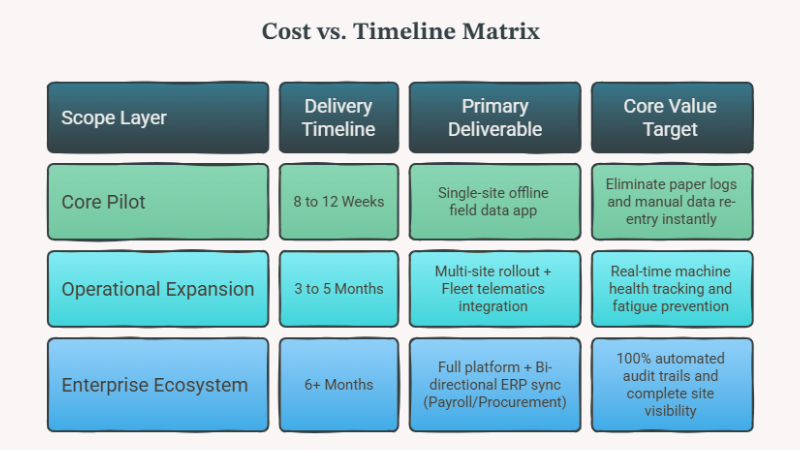
What a custom mining operations platform costs and how long it takes
Ask five custom software development companies for a quote and you’ll get five different numbers. Bespoke software development cost tracks scope, not headcount, and scope is the part most briefs get wrong.
That gives you two realistic starting points, not one:
- A single-module pilot, field data capture for one site, typically runs in the tens of thousands and takes eight to twelve weeks
- A full platform spanning field data, fleet and compliance, integrated with your ERP, is a six-figure build measured in months
Start with one module, prove it on one site, then expand. Cost per module drops once your core architecture and ERP integration already exist.
Our guide on choosing a custom software development partner in Australia covers what to check before you sign anything.
Get two or three custom software development services to quote against the same scope document. That’s the only way the numbers mean anything.
Ready to close the gap between your pit and the office?
Stop fighting manual spreadsheets that can’t talk to your fleet, and stop paying for rigid corporate modules that don’t survive a single shift in the Pilbara.
Let’s map out a single-module pilot engineered specifically for your site’s operational realities, offline requirements, and compliance calendar.

FAQs
1. What software do mining companies in WA typically use for field operations?
A mix. Generic safety and inspection apps, paper forms in older processes, and a growing number of custom-built tools shaped around one site’s specific checklists and hazards.
2. Can custom software work offline at remote Pilbara or Kimberley sites?
Yes. Offline-first architecture is one of the main reasons sites move to custom software, not a limitation of it. The app keeps working with zero signal and syncs once it reconnects.
3. How does custom fleet management software integrate with existing mining systems?
Through an API layer that pulls data from your existing telematics, maintenance logs and ERP, rather than replacing any of them.
4. What does a custom safety reporting platform cost for a WA mining company?
A standalone compliance and incident reporting module costs less and ships faster than a full integrated platform. Most sites start there and expand once it’s proven.
5. Can a small or mid-size WA mining company afford custom software, or is it only for majors?
Custom software development is not just for tier-one miners. A single-module build scoped tightly around one problem, field data capture or compliance reporting, sits well within reach for mid-size operators. Starting small and expanding is how most companies do it.