
Custom Software Development Cost in Australia: 2026 Pricing Guide
Table of Contents

Off-the-shelf software works fine. Until it doesn’t. The tool that used to save time starts needing three workarounds a day, or a compliance requirement lands that the platform just can’t handle. That’s usually when “what does custom software development cost in Australia?” stops being a curiosity and turns into an actual line item someone has to justify.
There’s no single number here. Anyone who quotes one before asking about your project is guessing, plain and simple. What follows is a realistic picture: how custom software development pricing in Australia is structured in 2026, what pushes it up or down, and roughly how long different builds take.
Why Businesses Move to Custom Software Development
Most companies start on ready-made platforms. They’re quick to set up, cheap to trial, and fine for a while. Then the cracks show. The software starts dictating how the team works instead of the other way round. Licence costs climb every time someone gets hired. Integrations with other systems turn into a patchwork nobody fully understands anymore.
Custom software development flips that around. You’re building custom business software to match how your team actually operates, not adapting your team to fit a generic product. It’s part of why bespoke software solutions have become common in government and public sector agencies, healthcare, financial services, and real estate and hospitality businesses, all sectors where the regulatory or operational constraints are specific enough that a generic tool just doesn’t fit.
Strip it back and the pitch for custom application development services is fairly simple. You own the features, the data, and the roadmap. New systems integrate with what you already run instead of forcing a workaround. Compliance and security get designed in from day one, not bolted on after an audit flags something. And there’s no per-seat licence bill creeping up every time you hire someone new.
How Custom Software Development Pricing Works
Every custom software development agency in Australia prices projects one of three ways, and which one fits has more to do with how well-defined your project is than which sounds cheapest on paper.
Fixed price suits a scope that’s locked in from day one. You get a defined deliverable and a known cost, which smaller builds and tighter budgets tend to prefer. The catch: flexibility goes out the window. Change the scope mid-project and you’re into change-order territory.
Hourly pricing means you pay for the time actually spent. It works better for projects likely to evolve, or ones running under an Agile methodology where priorities shift sprint to sprint. Typical 2026 rates for custom software development services in Australia land around:
- Junior developers: $60–90/hr
- Mid-level developers: $90–140/hr
- Senior developers: $140–200+/hr
Hybrid is a fixed quote for the core build with hourly billing for whatever gets added afterwards. Most mid-sized Australian businesses end up here, especially when the plan is a lean initial release followed by a phased rollout. It’s also easier to manage with a dedicated project manager keeping scope and budget honest week to week, rather than finding out at the end that they drifted apart.

Custom Software Development Cost by Project Type
Simple custom software, the internal tools, basic web or mobile apps, and early MVPs, usually takes 1–3 months. Minimal integrations, limited functionality, smaller budget to match.
Mid-level custom business software is where most Australian businesses actually sit: 3–8 months for things like bespoke CRM and ERP systems, customer portal software, booking and scheduling platforms, or SaaS platform development. More moving parts. More testing. More integration work than the simple tier, obviously, but not yet at enterprise scale.
Enterprise and bespoke software solutions run 6–12+ months. These are the platforms built for scale and security: enterprise software development for fintech or healthcare, workforce scheduling across multiple sites, data analytics and business intelligence platforms, custom AI development integration layered onto existing infrastructure. The cost is higher because the stakes are higher if something breaks.
Project type | Estimated timeline |
Simple software | 1–3 months |
Mid-level software | 3–8 months |
Enterprise software | 6–12+ months |
What Actually Moves the Price
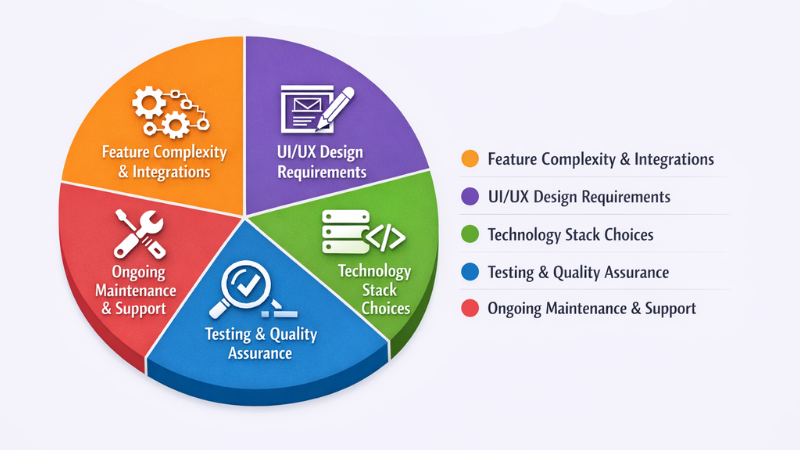
A few things do most of the work. Secure API integration with a legacy system takes longer than connecting to something modern built in the last five years, no way around that. UI and UX design time varies a lot too; a responsive web application development build for the public needs far more polish than an internal admin tool three people will ever open.
The technology stack matters, just not in the obvious way. Some stacks are faster to build in. Others are cheaper to maintain once the thing is actually live. You’re not avoiding that trade-off, just picking which end you’d rather pay for.
Testing and quality assurance aren’t optional once quality management systems come into play for anything touching finance, healthcare, or government data. Hosting is its own decision: scalable cloud hosting infrastructure costs more to set up than a basic server, but ages considerably better once traffic actually grows. And then there’s ongoing maintenance, which everyone budgets for the build and somehow forgets for afterwards.
Delays, when they happen, are rarely about the code itself. They’re scope changes halfway through, or an approval sitting in someone’s inbox three weeks longer than the plan assumed.
How to Keep Costs Under Control
Custom software development doesn’t have to blow out your budget, though it certainly can if nobody’s watching it. Start with an MVP instead of the full vision. Build the feature that solves the actual bottleneck before the ones that would just be nice to have. Plan for scale before you need it, since retrofitting it later almost always costs more than building it in from the start would have.
A round of strategic technology consulting before scope gets locked in tends to pay for itself many times over. And leave room in the budget for what happens after launch. That’s usually where the real return shows up, often through business process automation nobody thought to plan for on day one.
Choosing a Custom Software Development Agency in Australia
Cost is only half the decision. The delivery model matters just as much, arguably more. Some Australian software development agencies run fully onshore. Some outsource entirely. Some blend both, and that blend is where a lot of the “software development outsourcing” pricing confusion actually comes from: a well-run onshore/offshore mix can bring the cost down without the delivery risk of shipping the whole build overseas.
Basecode works this way, with teams across Sydney, Melbourne, Perth, Gold Coast, and Adelaide delivering custom software design and development, cloud application development, and secure web-based applications for government, healthcare, finance, real estate, and hospitality clients. Whether you’re after bespoke software development in Perth, a Sydney-based build, or something fully remote, the thing that actually matters is clear scope, a dedicated project manager, and no surprises when the invoice lands.
Ready to get a clearer picture of what your project would actually cost? Request a free project estimate and get a realistic budget and timeline before you commit to anything.

FAQs
1. Is custom software development worth the cost?
For most growing businesses, yes. The upfront cost is higher than an off-the-shelf subscription, but you stop paying per seat forever and the system is actually built around how you work, not the other way round.
2. How long does custom software development take in Australia?
Anywhere from a month for a simple app to well over a year for an enterprise platform. Most mid-sized projects land somewhere in the 3–8 month range.
3. Can I start small and scale later?
Yes, and honestly it’s usually the smarter path. Launching an MVP first and expanding once you know what people actually use beats paying upfront for features nobody touches.
4. Do I own the source code?
Typically, yes, though it depends entirely on the contract. Confirm IP ownership terms before signing, not after.
5. Do you provide post-launch support?
Usually it’s a separate ongoing arrangement rather than bundled into the build cost. Worth budgeting for from the start instead of treating it as an afterthought once launch day arrives.