
How Do You Calculate the Total Cost of Ownership for Custom Software Development?
Table of Contents
You got a quote for custom software. It felt expensive. So you went with a SaaS tool instead, maybe two, maybe five, and told yourself you’d revisit it later.
That was three years ago.
Now you’re paying for a stack of subscriptions that overlap, watching your team build spreadsheets to fill the gaps, and wondering why the software never quite fits the way you work.
The decision wasn’t wrong. The calculation was.
Most business owners compare a $90,000 build quote against $500 a month and the SaaS option looks obvious. But that’s the wrong comparison, because it stacks two different things against each other. One is the purchase price. The other is the opening line of a much longer invoice.
The number that actually matters is the one no quote ever shows you. Total cost of ownership for custom software is what the system costs to run, maintain and grow with, not just what it costs to build. Get that number wrong and you’ll keep choosing options that feel affordable until they don’t.
Why the Build Price Hides the Real Number
Here’s what makes this hard: the build cost is the only figure that shows up in a quote. Everything else stays invisible until you’re already committed.
Take a $500-a-month SaaS platform. In year one that’s a modest annual spend. Add five users, hit a feature ceiling, upgrade to the next tier, bolt on an integration tool because the native one falls short, and that number quietly climbs. Then your team grows. Then the vendor changes its pricing model, which it eventually will. You don’t notice the creep until you run the real numbers a few years in and feel slightly sick.
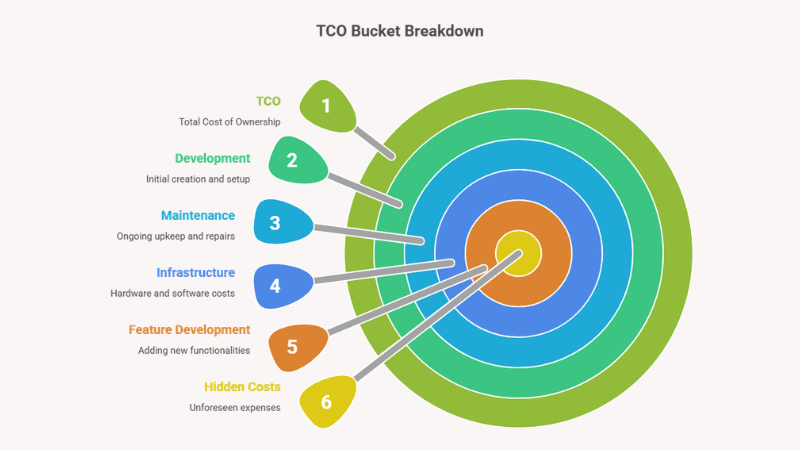
Custom software has its own full picture too. Total cost of ownership for a custom build covers:
- Initial development and design work
- Cloud infrastructure: servers, storage, backups, environments
- Annual maintenance: security patches, dependency updates, bug fixes
- New feature development as the business changes
- Staff onboarding and internal training
- Systems integration work as your stack grows
Neither option is “cheap.” But only one has a cost curve that flattens over time. The other keeps climbing.
So before comparing anything, ask a different question. Not “how much does it cost to build?” Ask: “how much does it cost to own for the next five years?” Any custom software development company worth calling should be able to walk you through that full-lifecycle estimate, not just hand over a build figure.

How to Actually Model TCO: Five Buckets, No Guessing
Gut feel doesn’t work here. You need a model, even a rough one, because a rough model beats no model by a wide margin.
Development costs
This is your foundation number, and it’s what drives the rest of the estimate. Custom software development in Australia spans a wide range depending on complexity, scope and who’s building it. That range is wide on purpose.
One way to control it early is to start with an MVP rather than the full product. You stage the investment, test what actually works, and avoid sinking a large budget into assumptions. Ask your custom software development services provider to separate the quote by phase: design, build, quality assurance, project management. Blended rates are fine until they’re not.
Infrastructure and hosting
Cloud costs feel small until they’re not. Budget for compute, storage, backups, a staging environment and monitoring as part of your scalable cloud hosting infrastructure. Costs scale with traffic and data volume, and they compound over a five-year horizon in a way that rarely makes it into the original pitch.
Maintenance and support
This is the line item that disappears from most quotes, and it’s the one that bites hardest. Plan for an ongoing annual percentage of your build cost in maintenance. It pays for security patches, framework updates, performance fixes and the small bugs that surface once real users start doing unexpected things.
You can cover this through a managed support plan or with an in-house developer. Many businesses find managed support more cost-effective at an early scale, so it’s worth running the comparison either way.
Feature development
Your business in year three won’t look like your business today. New team members, new processes, new customer expectations: software that can’t grow with you isn’t an asset, it’s a liability.
Set aside a separate budget for new features, on top of maintenance. The alternative is software that slowly stops fitting, and a team that quietly starts building workarounds. That’s how vendor lock-in starts, not with a contract clause but with a gradual mismatch between what the software does and what the business needs.
The costs that never show up on an invoice
These are the ones that make TCO calculations interesting.
- Productivity drag. Your team is adapting to the software instead of the other way around. How many hours a week? Multiply by their hourly rate, then by 52.
- Integration failures. Two systems that don’t talk properly are a tax on every process that touches both.
- Data portability. If you ever need to move platforms, what does it actually take to get your data out in a usable format?
- Compliance exposure. If your software doesn’t meet your obligations under Australian privacy or industry regulations, what’s the full cost, not just the fine?
You don’t need exact numbers here. Directional estimates are enough to show whether you’re optimising for the right thing.
Custom Builds vs SaaS: Where the Curves Diverge
SaaS platforms are quick to launch and cheap to trial, which is exactly why they’re the default starting point for most businesses. The trade-off shows up later: per-seat pricing, tier upgrades, and features you’re renting rather than owning. A bespoke CRM and ERP system, a customer portal, or a workforce scheduling tool built specifically around your processes carries more upfront investment but a flatter cost curve over time, because you’re not paying an ongoing licence for functionality you’ve already built and own outright.
This is also where systems integration and secure API integration matter. A custom build designed to talk to your existing tools from day one avoids the patchwork of connector apps and manual workarounds that quietly inflate SaaS TCO over a few years.
Calculating TCO for Your Own Business
A practical model doesn’t need to be complicated. Map out, for both options, a five-year view across development or subscription costs, infrastructure, maintenance, feature development, and the hidden productivity and integration costs above. Even directional numbers, without precise pricing, will usually show a clear pattern: one option flattens, the other compounds.
This is the same exercise we walk clients through at Basecode before any build starts, because a five-year view changes the decision more often than a first quote ever does.
Choosing a Partner Who Plans for the Full Lifecycle
A custom software development agency that only quotes the build is only giving you half the picture. Look for a provider who talks about maintenance plans, a dedicated project manager, agile methodology, and business process automation as part of the initial conversation, not as an upsell six months in.
Basecode works across custom software design and development, custom AI development integration, cloud application development, and web development, with delivery teams across Australia. Whether the brief is a government, healthcare, finance or e-commerce platform, the same principle applies: a system built to fit your business should also be cost to fit your business, for the full five years, not just the first invoice.

FAQs
1. Is custom software always more expensive than SaaS over five years?
Not reliably. It depends on how fast you’re growing, how well the SaaS actually fits your workflow, and whether you’d be paying for workarounds. The five-year model answers this for your specific situation generalisations don’t.
2. What should I budget for maintenance after launch?
15–20% of your initial build cost per year is a workable benchmark. On a $120,000 build, that’s $18,000–$24,000 annually. Some years you’ll spend less. After a major upgrade cycle, potentially more.
3. Can I get a TCO estimate before committing to a build?
Yes, and you should expect one. It won’t be a precise figure, there are too many variables but a good custom software development company should give you a range with clear assumptions attached.
4. What's the TCO mistake most businesses make?
Not pricing their own team’s time. The hours your people spend on manual workarounds, re-entering data between systems, or navigating software that wasn’t built for how you actually work that’s a real cost. It just never shows up on a vendor invoice.
5. Does starting with an MVP change the TCO picture?
It usually helps. You spend less upfront, validate before you scale, and avoid the most expensive mistake in software development building the wrong thing well.