
AI MVP Development: How Founders Can Launch Lean and Scale Smart
Table of Contents
What Is AI MVP Development?
It’s pretty straightforward: you’re using AI tools to speed up the process of building your Minimum Viable Product. Design, code, testing, validation all of it.
The old playbook looked like this:
- Hire developers
- Code for 3 – 6 months
- Launch and cross your fingers
Now you can:
- Use generative AI to build your MVP
- Work with AI coding assistants
- Prototype rapidly with AI tools
- Automatically analyse user feedback
Instead of doing everything by hand, you work alongside AI systems that help with ideas, wireframes, backend logic, even simulating customer support.
AI doesn’t think for you. It just helps you execute faster.
Why Early-Stage Founders Should Consider This
- You Get to Market Way Faster
Speed matters. With AI prototyping, you can:
- Whip up UI mockups in minutes
- Turn wireframes into working code
- Build landing pages instantly
- Create onboarding flows automatically
You’re testing your idea in weeks, not months.
- It’s Cheaper
A full-stack team costs tens of thousands every month. With AI, you can:
- Keep engineering costs low early on
- Validate before you start hiring
- Avoid building features nobody needs
If you’re bootstrapping, this is huge.
Related blog: Custom Software Development Cost in Australia: 2026 Pricing, Timelines & Project Types
- You Validate Smarter
AI can help you:
- Generate user surveys
- Analyse competitors automatically
- Run sentiment analysis on feedback
- Model demand before launch
You’re working with data instead of hunches.
- You Can Iterate Like Crazy
Traditional dev cycles lock you into long sprints. AI tools let you tweak features, refine UX, and test variations instantly.
You can iterate every day instead of every month.
How to Actually Build an MVP Using AI (Step-by-Step)
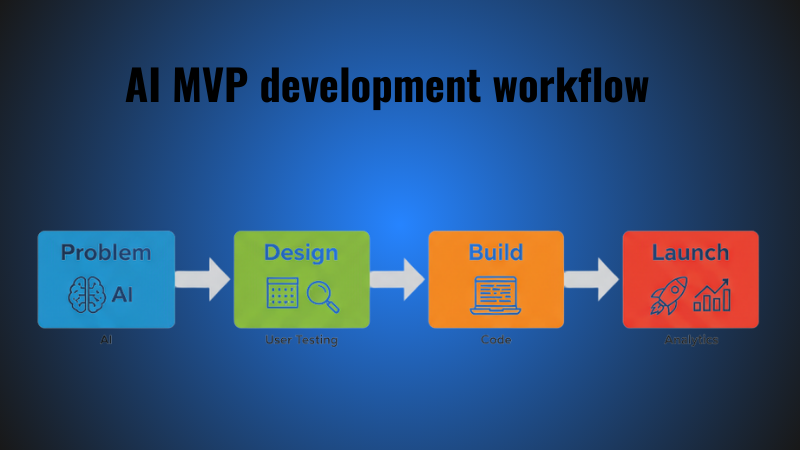
Let me walk you through this.
Step 1: Validate the Problem First
Before you build anything, use AI to:
- Dig through Reddit and community forums
- Find patterns in what people complain about
- Spot gaps in what competitors offer
- Build user personas
You can surface insights that used to require hiring a research firm.
This saves you from building something nobody wants.
Step 2: Design with AI
Generative AI can:
- Create wireframes from your descriptions
- Suggest user flows
- Draft product requirement docs
- Help you prioritise features
You’re not starting from scratch. You’re refining what AI drafts for you.
You stay in charge. AI just speeds up the early stages.
Step 3: Build with AI Coding Assistants
AI coding tools help you:
- Generate backend APIs
- Write frontend components
- Debug your code
- Optimise database queries
- Generate test cases
Even if you’re not technical, you can prototype something functional with AI-assisted platforms.
That said, you still want someone with experience reviewing things. AI moves fast, but you need human oversight for architecture quality and security.
Step 4: Launch Something Lean
Your first release should:
- Solve one real problem
- Only include essential features
- Collect feedback you can measure
Use AI chatbots for onboarding help. Use AI analytics to track what people actually do. Use AI-driven A/B testing to compare versions.
Get it out there. Learn fast.
Step 5: Optimise Based on Real Data
Once users start using your MVP, AI can:
- Spot churn signals
- Show where people drop off
- Summarise feedback automatically
- Group feature requests
Instead of reading through hundreds of responses manually, you get actionable insights right away.
AI MVP Development vs Traditional MVP Development
|
Traditional |
AI-Enabled |
|
3–6 month build cycle |
2–6 week prototype |
|
Big team upfront |
Lean workflow with AI |
|
Expensive validation |
Data-driven validation |
|
Slow iteration |
Rapid testing |
|
High burn rate |
Much cheaper |
The traditional approach still makes sense for complex enterprise stuff. But for early-stage SaaS, marketplaces, or AI-powered platforms? AI prototyping cuts out so much friction.
Use Cases That Work Really Well
AI MVP development is especially good for:
SaaS Startups
- Workflow automation
- CRM extensions
- Analytics dashboards
HealthTech
- Appointment scheduling
- AI triage systems
- Telemedicine MVPs
FinTech
- Budgeting apps
- Risk dashboards
- AI advisory tools
EdTech
- Micro-learning platforms
- AI tutoring prototypes
- Assessment tools
In every case, you validate your core assumptions before spending big money on infrastructure.
Best AI Tools for Validation
People always ask: what tools should I actually use?
Tools change constantly, but effective validation usually includes:
- AI survey generators
- Automated competitor analysis
- Trend prediction tools
- Behavioral analytics
- No-code AI prototyping platforms
The trick isn’t using more tools. It’s using the right workflow.
Simple often beats complicated.
Common Mistakes to Avoid
Even with AI, founders still mess up:
- Building Too Many Features
Just because AI makes it easier doesn’t mean you should build everything.
- Ignoring Human Judgment on UX
AI can generate interfaces, but understanding users still requires human thinking.
- Skipping Validation
Speed doesn’t replace strategy. Always validate before you scale.
- Treating AI Like a Magic Wand
AI helps your team. It doesn’t replace vision, expertise, or leadership.
What's Coming Next
We’re heading toward a world where:
- MVPs get built in days
- Iterations happen in hours
- Validation runs automatically
- Founders orchestrate AI instead of doing everything manually
But trust, security, and quality will matter even more. Investors and users will still judge you on clarity of vision, usability, and whether you can scale long-term.
AI speeds things up. It doesn’t think for you.
How do I validate my idea before I build?
Use AI for:
- Demand analysis
- Community sentiment mining
- Landing page testing
- Automated feedback clustering
Validate before launch and after launch.
Is AI prototyping secure?
Depends how you implement it. Handle sensitive data carefully and involve experienced people in architecture decisions.
Final Thoughts: Build Smarter, Not Bigger
The startup world rewards speed but punishes waste.
AI MVP development gives early-stage founders a real edge:
- Faster experiments
- Lower burn rate
- Smarter validation
- Data-backed decisions
The founders who win won’t necessarily build the biggest teams first. They’ll build the smartest workflows.
If you’re unsure how to structure your MVP or prioritise features, our tech consultancy services can guide you through planning, architecture, and launch strategy.
Start learning. Validate early. Scale when you’re ready.

FAQs
1. What is AI MVP development in simple terms?
It’s using AI tools to help you design, build, and test your minimum viable product. You get to launch faster and spend less money than you would going the traditional route.
2. How can AI tools help build an MVP faster?
They handle a lot of the grunt work wireframes, generating code, debugging, testing with users, analysing feedback. What used to take months can now take weeks.
3. Is AI MVP development suitable for non-technical founders?
Yeah, absolutely. AI coding assistants and no-code tools let you build prototypes even if you can’t code. That said, you’ll still want someone technical to review things before you really scale up.
4. Does using AI reduce MVP development costs?
It does. You can keep your team smaller early on and move faster, which cuts down on how much you’re spending in those critical first months.
5. Can AI completely replace developers in MVP development?
No, while AI can help to accelerate your MVP development, you still need to have real developers in order to make informed decisions regarding things like Architecture, Security, and ensuring that the overall system works properly when scaled.