
Why Software Projects Go Over Budget in Australia - and Who Usually Pays for It
Table of Contents

Nobody signs a software contract expecting it to blow out. The quote looked reasonable. The vendor seemed across it. Then the emails start arriving: a change request here, a revised estimate there, and by month four you are staring at a number that bears no resemblance to what you agreed.
This happens constantly in Australia. Not because software is inherently unpredictable, but because most projects start without the right foundations. The red flags were there before signing. Most people did not know what they were looking at.
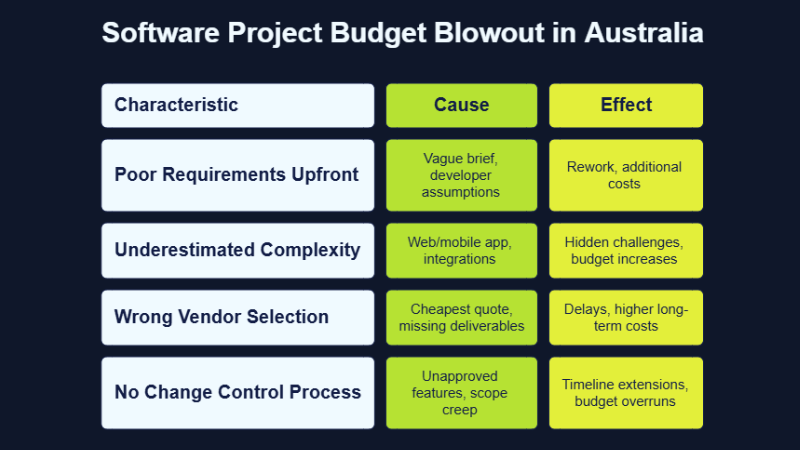
The four reasons most Australian software projects blow their budget
Failed projects rarely have exotic causes. The same issues come up time and again, and none of them are hard to spot once you know the pattern.
Poor requirements upfront- A vague brief hands control to the developer. They fill the gaps with assumptions, and you pay to fix those assumptions when they turn out wrong, which they usually do.
Underestimated complexity- Web application development, mobile app development, system-to-system integration each has hidden layers that a fast quote does not account for. Vendors who quote quickly have often not looked closely enough.
Wrong vendor selection- Choosing on price is understandable. It is also where most budget disasters begin. The savings at sign-off get eaten by change requests, delays, and rebuilds further down the track.
No change in control- Without a formal process for managing additions, scope expands quietly. A “small tweak” here, a revised feature there, and the project doubles in size without anyone signing off on the cost.
Ask any custom software development partner you are considering to describe their change control process. If they cannot give you a clear answer, that tells you something important.
Scope creep: what it is, how it starts, and how to stop it
Scope creep does not arrive with a warning. That is what makes it expensive.
What is scope creep in software development?
It is the slow accumulation of additions that were never in the original brief. The project does not formally expand; it just drifts. Each request seems reasonable on its own. Together, they add weeks to the timeline and thousands to the bill.
The pattern is familiar to anyone who has been through it. “Can we add a reporting dashboard?” “Can the mobile app connect to our accounting software?” Nobody frames these as scope changes. But each one is, and each one costs real development time.
How to keep it contained:
- Get requirements locked in writing before development starts
- Every addition goes through a formal change request, not informal agreements
- “Small changes” get priced before they get built, not after
- Work with custom app development teams who treat scope discipline as standard, not optional
A partner who says yes to everything without flagging cost or timeline impact is not being helpful. The bill is just building somewhere out of sight.
Why a cheap quote is usually the most expensive option
It is not unusual to receive two quotes for the same project where one costs significantly more than the other. The gap is not always about quality, often it is about what the cheaper quote leaves out.
Cheap quotes tend to share a few traits:
- Requirements treated as complete when they are not
- Testing, deployment, and post-launch support excluded quietly
- Offshore resourcing costs buried behind a local-looking pitch
- Margin to be recovered later through change requests
The real damage from a failed build is not just financial. You lose time you cannot get back. You often end up paying a second development company to fix or rebuild what the first one delivered. That second bill rarely gets counted when people compare the original quotes.
When you are weighing up app development companies in Melbourne, Sydney, Perth, or anywhere else, ask for a full list of exclusions. That is the part of the quote that tells the honest story.
The discovery phase is the budget's best protection.
Most developers will not tell you this upfront, but a discovery phase is the single best thing you can do to protect your budget before a line of code gets written.
Discovery is a short, paid engagement, typically a few weeks, where the team works through your requirements in detail. The output is a functional specification, a technical architecture, and a realistic cost estimate based on actual scope rather than guesswork.
Skipping discovery is a false economy. Without it, developers are building from assumptions, and you are paying to revise those assumptions as the project runs.
What a proper discovery phase gives you:
- A detailed specification that both sides have agreed on
- A technical architecture so there are no surprises mid-build
- A milestone-based timeline with real checkpoints
- A budget estimate grounded in defined scope, not optimism
If a web app development company skips straight to a full build quote, push back. Any reputable custom software developer in Melbourne, Brisbane, Sydney, or elsewhere will want to do this properly. It protects their delivery as much as your budget.
Contract terms that prevent cost blowouts
Most businesses sign software contracts without reading them closely. That is where the problems get locked in.
Read for these specifically:
- Scope of work: is it specific, or does it leave room for interpretation?
- Change requests: is there a written process, or is it left open?
- Payment structure: tied to delivered outputs, or to calendar dates?
- IP ownership: does the contract confirm you own what you pay for?
- Source code access: can you pull the code at each milestone?
- Dispute resolution: is there a defined process, or a vague clause?
Loose scope language is the vendor’s friend and yours to regret. If the contract lets the supplier decide what counts as “in scope,” you have already lost that argument before it starts.
Negotiate these terms before you sign, trying to renegotiate mid-project, when momentum is on the developer’s side, rarely goes well.
How to read a software quote before you accept it
A quote tells you more than a price. The way it is structured, what it includes, and what it skips reveals a lot about how the vendor actually works.
Before you accept anything, get answers to these:
- What is explicitly not included in this quote?
- How are change requests priced and approved?
- Does the quote cover testing and QA, or just development?
- What is the process if the project runs over the estimate?
- Who holds the IP and source code during development?
Two quotes for the same project can look similar in price and be completely different in scope.
The one that includes a proper discovery phase, milestone-based delivery, and a written change control process will nearly always cost you less in the end even if it costs more at the start.
Treat the quote like an interview. What a vendor puts in writing and what they leave out tells you how they will behave once the contract is signed.
If you want to know what a properly scoped, well-run software project looks like before you commit, talk to the Basecode team.

FAQs
1. What is scope creep in software development?
New requirements get added after the brief is locked, usually without anyone formally agreeing to the cost or timeline impact. It tends to creep in through small requests that nobody flags as scope changes, which is exactly why budgets are gone before anyone realises what happened.
2. How do I stop a software project from going over budget?
Run a discovery phase before development starts, get requirements locked in writing, and make sure every scope addition goes through a formal approval with a cost attached. Most blowouts trace back to skipping at least one of those three.
3. Is it normal to pay for a discovery phase before the project starts?
Yes. Reputable custom software developers charge for it because it takes real time and skilled people. Paying for discovery upfront is far cheaper than fixing a poorly scoped build mid-project.
4. What should a software development contract include?
At minimum: a specific scope of work, a written change request process, payments tied to delivered milestones, clear IP ownership, and source code access at each stage. Vague contracts favour the vendor.
5. Is a fixed price or time-and-materials contract better for my project?
If your requirements are fully defined, a fixed price gives you cost certainty and keeps the risk with the vendor. Time-and-materials makes sense when scope will evolve. Neither protects you without a solid discovery phase. First, the contract type changes who carries the risk, not whether the risk exists.