
When Low-Code Is Not Enough: Why Enterprises Still Choose Custom Software
Table of Contents
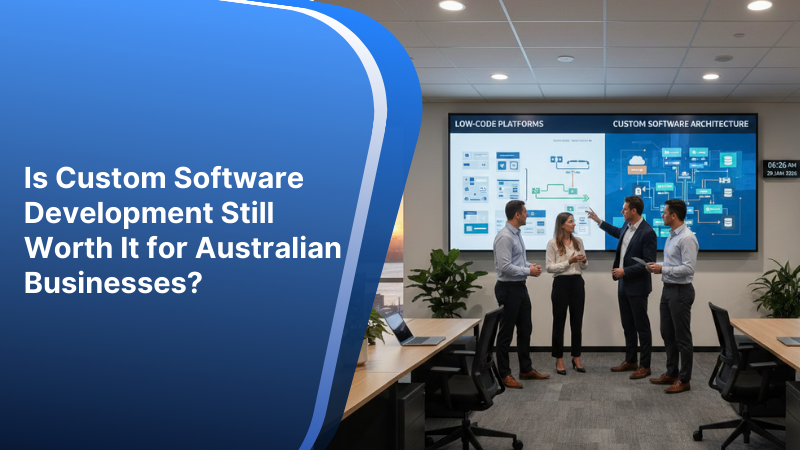
Low-code and no-code platforms have become mainstream across the global tech landscape. With everything from rapid prototyping to automating internal workflow, these tools claim to cut down on development time and reduce engineer dependence. They offer a fast route to digital enablement, particularly for smaller organisations.
But for B2B companies and long standing Australian institutions, the discussion has turned. As systems grow, compliance standards become stricter, and customer experience rises in importance, many leaders are rethinking whether low-code solutions are sufficient to support their long-term needs.
The reality is clear. If your organisation demands scalability, integration, security and strategic control- then investing in custom software development is a must. And in many instances, solutions like Genesys custom dev also offer that depth and flexibility which you just can’t get out of a low-code platform.
Low-Code and No-Code Platforms on the Rise
Low-code and no-code platforms were created to simplify development. They provide visual builders, pre-built business logic and integration to enable teams to build applications rapidly, often with little or no coding knowledge.
Australian enterprises use these platforms predominantly for:
- Internal dashboards and reporting tools
- Simple workflow automation
- Proof-of-concept applications
- Department-level productivity tools
They’re adding value when speed and simplicity are paramount. However, they are not built for long-term, complex enterprise environments.
What Low-Code and No-Code Won't Do for Enterprises
Technology Needs for Growing Businesses. As companies grow, technology needs get more complex. Here’s where the walls start to crumble around a low-code or no-code platform.
Common enterprise challenges include:
- Lack of capability to handle complex business logic
- Performance limitations at high data volumes
- Challenges to interface with old and vendor-specific systems
- Proprietary and unpredictable licensing costs
- Limited command over security and compliance policies
For B2B businesses that span multiple systems, departments and regions, these components become a source of operational risk, not mitigation.
Because Custom Software Development Is Still Necessary
Through custom software development, businesses can design technology alongside the business, not vice versa. Each function, integration, and workflow is developed to support certain operational objectives.
With custom development, organisations gain:
- Total freedom with regard to architecture and technology stack
- Real-world, business-oriented software
- Freedom from third-party platform constraints
- Business growth-driven systems.
Genesys is rolling out immersives like its custom dev focus less as tactical game‐changers and more as long-term strategic responses. This is a great way for Australian businesses to control their operations or industry-specific needs at the current moment.
Scalability Designed for Long-Term Growth
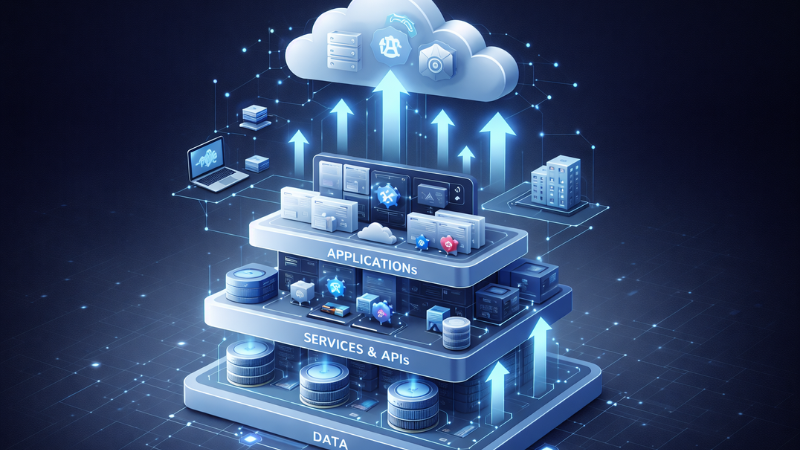
One of the biggest considerations for enterprise software is scalability. The systems that work well today will also have to keep working as user numbers, transaction volumes and data complexity increase.
Custom software development enables:
- Cloud-native or hybrid architectures
- Horizontal and vertical scaling strategies
- So, performance optimisation at any system layer
- Expansion into new markets or services for the future
Scalability is not a feature that can be opted out of for Australian companies looking to expand nationally or regionally within APAC. It is a business requirement.
Ownership, Control, and Minimised Vendor Risks
Low-code platforms inject key systems into third-party ecosystems. This can, over time, restrict strategic flexibility and inflate costs.
With custom software, you have full control over:
- Source code
- Intellectual property
- Infrastructure decisions
- Data models and integrations
For B2B businesses, that’s ownership, meaning diminished long-term risk of your tech decisions being controlled by the limitations of a platform.
Australian Standards Compliant Security and Compliance
Restrictions on personal information in Australia: Australian businesses are required to work within tight parameters of data protection and compliance. Sectors including finance, healthcare, education, logistics and government are now under a closer watch in terms of data management and system security.
Custom software development supports:
- Tailored access control and authentication
- Risk-based encryption for business use cases
- Compliance with Australian privacy regulations
- Integrated with third-party as well as legacy trusted systems
Low-Code platforms provide standard security capabilities to a certain extent, but the real enterprise risk management never gets covered here.
Seamless Integration Across Enterprise Systems
Meanwhile, conventional businesses have a mix of modern and legacy systems. ERP systems, CRMs, finance applications and operational databases need to connect perfectly to one another.
Custom software development enables:
- Strong integration with current enterprise systems
- Bespoke APIs for internal and external systems
- Cross-department and data source automation
- Minimized data siloes and manual workflows
Integration is a primary principle of design for Genesys custom dev solutions, placing systems in the service of operational efficiency, instead of adding layers of new complexity.
Performance (and UX) as a Competitive Advantage
Enterprise software is functional no more. It has to be quick, intuitive, and dependable.
Custom development enables teams to:
- Application performance and response times
- User experience for internal teams and customers
- System reliability under peak loads
For both customer-facing applications and internal enterprise tools, performance has a direct correlation to productivity, satisfaction, and profit.
Long-Term Value Over Short-Term Convenience
While low-code platforms reduce upfront costs, long-term expenses often increase through licensing fees, platform constraints, and redevelopment efforts.
Custom software development provides:
- Predictable long-term investment
- Reduced reliance on external platforms
- Software that grows with your vision
Custom development leads to greater return on investment over time for Australian businesses looking at long-term growth.
Low-Code vs. Custom Software: A Fusion of Both
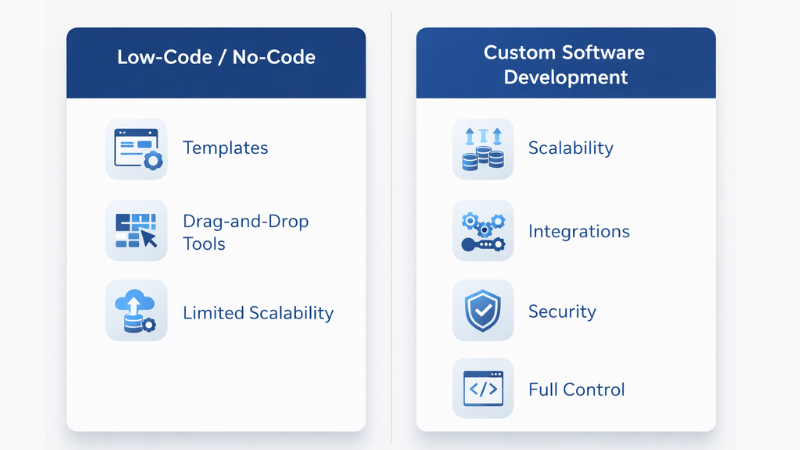
This is not a one-or-the-other proposition. The same organisations do a good job of synthesising both.
A balanced approach looks something like this:
- Low-code: Your internal tools and rapid experimentation
- Bespoke software for your key business systems
- Well-defined distinctions between tactical and strategic levels
The trick is which systems are business-critical with a need for long-term stability.
Final Thoughts
Low-code, if not no-code, platforms have revolutionised the way enterprises experiment and innovate. But for B2B companies and Australian scaleups, they don’t replace the requirement of custom software development.
Subject Matter Experts – The custom solution provides scalability, ownership, security and performance that generic platforms can’t match. Methodologies like Genesys custom dev are a clear indication that well-thought-out, on-purpose-made software remains a competitive differentiator.
Choosing the right technology is not about what’s trendy. It’s simply about creating systems that aid long-term business growth in an ever-expanding digital economy.
FAQs
1. Is there still a place for bespoke software development in 2026?
Yes. Custom software continues to be critical for the growth of a company: scaling, security, integration, and competitive differentiators.
2. When should an enterprise choose custom software over low-code?
Custom software makes more sense for systems that are business-critical, or need to perform complex logic, scale reliably, or manage sensitive data.
3. Australian SMEs and custom software development – is there a match?
Absolutely. A lot of Australian SMEs are relying on bespoke software to streamline operations, unify systems and remove the constraints inherent in off-the-shelf platforms.
4. Is Genesys' custom development good for the enterprise?
Yes. Genesys custom dev methodologies are designed to map your software architecture to meet enterprise business needs, compliance and scale in the long term.
5. Is it possible for low code and custom development to cooperate?
Yes. Low-code can be used for in-house automation, and proprietary software can drive the core systems.