
Why Software Vendor Lock-in Is Quietly Draining Your Business
Table of Contents
You probably felt it at the last renewal.
Price up. Features you actually need now sitting behind a more expensive tier. And when you asked about moving your data somewhere else, the answer was some version of “that’s complicated.”
That’s software vendor lock-in. Getting out costs more than staying. They know it. That’s the whole game.
What Is Software Vendor Lock-in?
It’s simpler than it sounds. Vendor lock-in is what happens when switching away from a software provider would cost so much in time, money, or chaos that you just don’t.
Not because the product is good. Because leaving got too hard while you weren’t paying attention.
A few ways it usually shows up:
- Your data is stored in a format that doesn’t export cleanly anywhere else
- Your team’s whole process is built around features specific to that platform
- The APIs your other tools connect through can be changed or killed without notice
- There are contractual penalties for leaving that weren’t obvious when you signed
And once the vendor figures out you’re trapped, the relationship changes. Renewals get harder to negotiate. Support gets slower. Feature requests for your use case keep getting deprioritised.
How Off-the-Shelf Software Builds the Trap
SaaS products are designed to get you in fast. What most people don’t think about is what that costs on the back end.
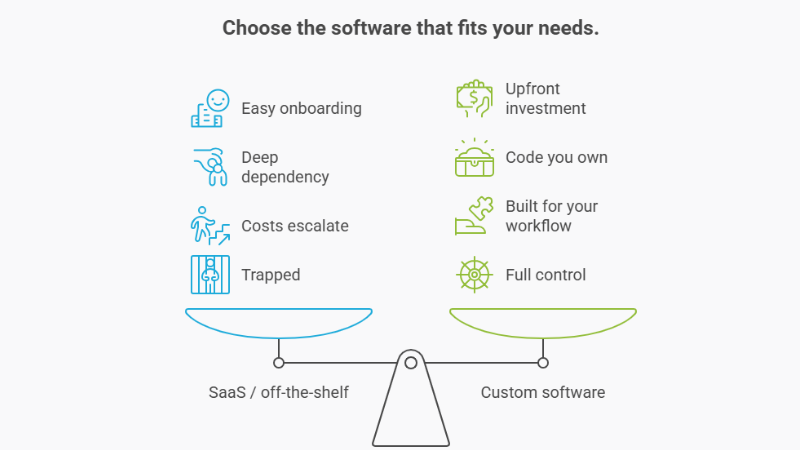
The smoother the onboarding, the stickier the exit. This isn’t a bug, it’s how the product is built to retain you.
When you roll out something like Salesforce, HubSpot, or a niche industry platform, your team learns its quirks. Your data moves into their infrastructure. Your reporting, automations, and integrations get assembled inside their walls.
A year in, you’re not really using the software. You’ve built around it.
That’s not a mistake you made. Off-the-shelf tools are built for a wide range of businesses, so they fit most of them imperfectly. You end up either bending your operations to suit the product or paying for customisations of that sort of work.
If your stack is already creating friction, it’s worth auditing it before you grow into the dependency further.
Why Custom Software Development Gets You Out
When you work with a custom software development company, the thing you’re actually buying is control over your own system.
The code is yours. The data structure is yours. If the relationship with the developer ends tomorrow, you still have a working product you understand and can hand to anyone.
There’s no annual price hike you have to absorb because switching is painful. No forced migration when a vendor decides to sunset the product. No scrambling because an API changed without warning.
Australian businesses working with local custom software developers get something else too: a system built around how they actually operate, not a generic workflow the vendor designed for the median customer.
In practical terms:
- Your data stays in formats you can move, query, and back up without involving anyone else
- Integrations with other tools are built to your requirements
- New features get added based on your timeline, not a product team’s quarterly priorities
- Headcount growth doesn’t trigger a pricing conversation
When Should You Actually Consider Custom Software?
Not every business should build from scratch on day one. But a few situations make it worth a serious conversation with custom software developers:
- You’re paying for multiple SaaS tools that cover overlapping ground
- A vendor changed their pricing or dropped a feature and it hurt you
- Half your team’s time goes into workarounds because the software doesn’t quite fit
- Your data is spread across platforms and getting a clear picture requires manual work every time
- You’re scaling and your current tools will cap out before you do
The honest framing: it’s not really build vs. buy. It’s whether you want to keep renting something that doesn’t fit, or invest in something that does. A proper cost comparison between ongoing SaaS spend and a custom build often surprises people when they run it past the two-year mark.
What to Actually Look For in Custom Software Development Services
The quality gap between providers is real. A few things worth checking before you commit.
Source code ownership needs to be in the contract, not assumed. Reputable custom software development companies hand over the full codebase at delivery. If what’s on offer is a licence to use software they retain ownership of, that’s the same lock-in problem with a different vendor.
Ask how they handle documentation. A system only the original developers can understand isn’t an asset, it’s a dependency. Good custom software developers build for handover, whether that’s to your internal team or another provider down the track.
Find out if they know your industry. Custom software development in Australia has expanded partly because local compliance requirements, integrations, and workflows are specific enough that offshore teams working from assumptions build the wrong thing. A team that already knows your context will ask better questions and get to working software faster.
Watch how they run the first conversation. If the pitch is about their tech stack before they’ve understood your problem, that’s worth noting. The best custom software solutions come from developers who push back on assumptions and want to understand the business before writing a line of code.

How the Move to Custom Software Usually Happens
Very few businesses rip out everything at once. Most start smaller.
Pick the part of your operation where the current software is costing you the most, whether that’s lost time, bad data, or money leaving through the wrong subscription. Build there first. Get something working that you own.
That first piece does a few things. It cuts one dependency. It shows your team what purpose-built software actually feels like. And it gives you a real data point on cost and timeline to work from when you decide what to build next.
From there, you keep what’s working in your current stack, replace what isn’t, and connect everything to the custom core you’ve built. Most businesses find the second and third projects easier, they already know the developer, the process, and what questions to ask.

FAQs
1. Isn't custom software development in Australia too expensive?
The upfront cost is higher than a monthly subscription. But SaaS pricing compounds: renewals go up, tiers get added, seat counts grow. Many businesses find a custom build pays for itself within two to three years, and after that the asset is yours with no ongoing licence cost.
2. What happens when our business needs change?
Users usually prefer a simple tool that works perfectly over a complex tool that is confusing or slow. In 2026, quality consistently beats quantity.
3. Can custom software connect with the tools we're already using?
Yes, and this is usually a design requirement from the start. Custom builds regularly integrate with existing CRMs, accounting software, industry platforms, whatever’s already in place.
4. How long does it take?
Scope drives timeline more than anything else. A focused initial build for a small or mid-size business typically runs three to six months. Phased approaches, where you launch one core feature set first can put something useful in your hands earlier.
5. Is our data more secure with custom software?
Potentially. You control hosting, access, and backup. That’s a responsibility, but it also means a breach at a third-party SaaS vendor doesn’t automatically become your problem.