
How Artificial Intelligence Is Redefining Custom Development Work
Table of Contents
Custom Development Is Evolving Fast
Remember when custom software meant waiting months just to see a working prototype? Big teams, endless meetings, timelines that kept slipping. And we all just… accepted it. Because what choice did we have?
In short, we’re done with the age of cool experimental technology.
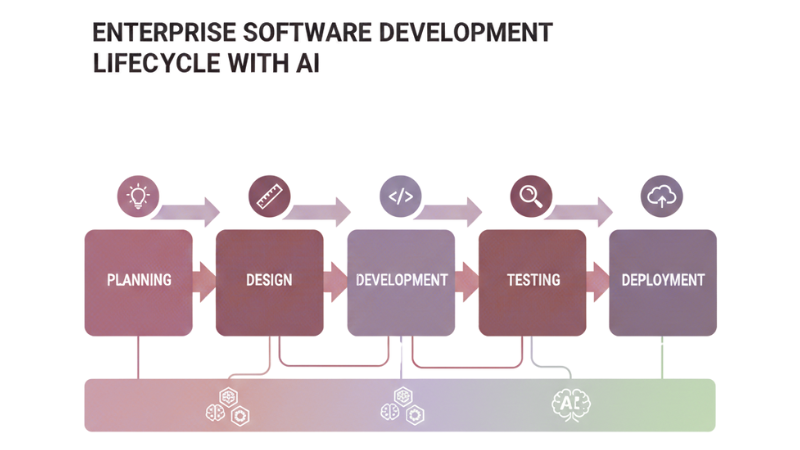
2026 – Artificial Intelligence has gone from a neat experimental tool, to being a part of our daily lives. Used for architecture design, actual coding, testing, and optimising code. AI has found its way into every phase of the software development lifecycle.
The ever-evolving world of software development, including custom development, will still exist; it is just going to receive a big-time facelift as a result of the advances within the field of AI.
This post walks through what’s actually happening with AI in custom dev work, what parts still need humans (spoiler: a lot), what’s getting automated, and what you should probably start thinking about if you don’t want to get left behind.
What "AI-Driven Custom Development" Actually Means
Okay, so when people say “AI-driven custom development,” they’re talking about using large language models and automation tools throughout your whole development process.
And no, it’s not about firing all your developers and letting robots take over. AI is more like that really good assistant who:
- Makes your coding go way faster
- Helps you make better decisions
- Catches mistakes you’d otherwise miss
- Keeps your documentation actually up to date
Your developers are still the ones making the big calls defining the logic, figuring out the architecture, setting business rules. AI just handles a ton of the tedious stuff, flags issues before they become problems, and keeps things moving.
Think of it this way: AI figures out how to do something, while humans figure out why we’re doing it in the first place.
Why This Is Happening Now
A bunch of pressures are converging all at once:
- Everyone’s in a hurry. Time-to-market keeps getting more competitive.
- Software systems are crazy complex now compared to even five years ago.
- Good developers are hard to find and expensive to keep.
- Your app needs to work on web, mobile, desktop.
- Maintenance costs are eating budgets alive.
AI addresses all of this by just… being smarter about how work gets done.
And it’s affecting everyone. Doesn’t matter if you’re a three-person startup trying to build an MVP or a Fortune 500 company trying to modernise a system from 1997 that somehow still runs your entire business.
AI addresses all of this by just… being smarter about how work gets done. According to McKinsey research, generative AI could add trillions in value across industries, with software development being one of the biggest beneficiaries.
What You Actually Get from AI in Development
Development That’s Actually Fast
AI tools spit out all that boring boilerplate code, suggest functions, catch logic errors while you’re still typing. Your developers spend less time writing the same patterns over and over, and more time on the features that make your product special.
You ship faster without the code turning into a mess.
Architecture Decisions That Make Sense
Those big language models can analyse your requirements, look at data flow, think about scale. They help compare different approaches, pick frameworks, see where performance might tank before you’ve built anything.
Your architects are still making the calls, they’re just making better calls because they have more information.
Way fewer “How Did That Get Through?” Bugs
AI tools catch the tiny errors that most people tend to miss. They act like real users to find security gaps early. Fewer big bugs reach your customers when you let smart software handle the hard work. You will not have to fix big problems at midnight anymore.
Keeping your code healthy should not be a struggle.
These smart tools scan your entire codebase much faster than any human coder could. They point out messy spots where work is piling up and show you how to fix them. You can update old parts without the whole system breaking. This keeps your software fresh and easy for everyone to handle. Instead of worrying about old systems falling apart, you can focus on building new things that people really love.
Where AI Fits In (Basically Everywhere)
Planning and Requirement Analysis
For stakeholders, user stories, and historical data, an AI system will analyse and identify gaps in requirements, logical conflicts between features, and unrealistic timelines. This allows project teams to have a clearer definition of scope and fewer surprises along the way.
Design and Architecture
When doing design and architecture work, developers can use AI to compare technologies/technology stacks, evaluate scalability options, estimate infrastructure costs, and validate the integration of systems. The result is design and architecture reviews that are faster and based on more relevant data.
Development and Coding
By using AI development and coding tools, developers can generate clean starter code, receive best practice recommendations, identify gaps in their workflows, help with application programming interface (API) integrations, and focus on problem resolution rather than coding.
Testing and Quality Assurance
Through AI testing and quality assurance tools, automated test case creation, continuous regression testing (where a portion of the tests for a project are run automatically every time there’s a change made), and the ability to modify tests based on actual usage patterns will improve quality without delaying the delivery time for the project.
Deployment and Monitoring
The deployment and monitoring functions of an AI system provide insight into performance, predict future system failures, and identify possible improvements to custom applications once the application has gone live. As a result, custom applications will continue to improve over time rather than degrade.
Who's Seeing the Biggest Changes
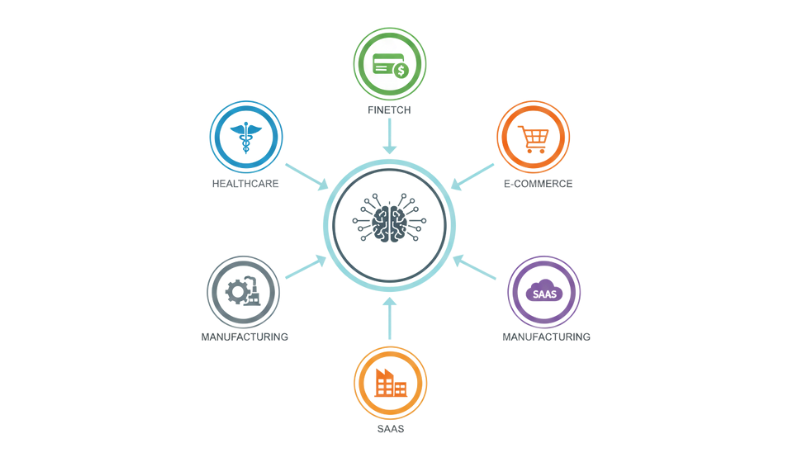
Healthcare is using AI to build compliant, secure software way faster. Systems adapt quicker when regulations change or patient data requirements shift.
Fintech platforms are improving fraud detection, speeding up transactions, handling bigger scale all with AI-assisted development.
E-commerce sites are evolving in real time based on what users actually do, inventory patterns, and what people are likely to buy next.
Manufacturing and logistics companies are optimising supply chains and predicting equipment failures before they happen.
SaaS startups are shipping MVPs in weeks instead of months and iterating constantly.
The Before and After
What We’re Talking About | The Old Way | With AI |
How fast things move | Slow, lots of manual work | Fast, AI handles the grunt work |
When you catch errors | Late, usually in testing | Early, sometimes while typing |
Maintenance | Fixing things when they break | Predicting problems before they happen |
Documentation | Outdated five minutes after you write it | Actually stays current |
Planning for scale | Based on experience and guesswork | Based on actual data |
AI doesn’t make complexity disappear. It just makes it manageable.
What AI Still Can't Do
Let’s be real. AI has limits.
You still need actual humans for:
- Figuring out business strategy
- Having product vision
- Making ethical calls
- Understanding what users actually need (not just what they say they need)
- Creative problem-solving when things get weird
What Developers Need to Focus On Now
If you’re a developer, coding skills alone won’t cut it anymore. You need to get good at:
- Thinking in systems
- Understanding the domain you’re working in
- Prompt engineering (yeah, it’s a real skill now)
- Orchestrating different AI tools
- Security and governance
Understanding why you’re building something matters more than ever. The “how” is increasingly handled.
Myths That Need to Die
“AI will replace developers.”
No. It replaces inefficient processes. Huge difference.
“AI-built software is low quality.”
Bad planning creates bad software. The tool doesn’t matter.
“Everything becomes generic with AI.”
Actually, AI lets you customize more because you’re not drowning in boilerplate.
What's Coming Next
Custom development isn’t going anywhere. It’s just evolving into something more strategic, more adaptive, more focused on outcomes instead of just outputs.
AI is turning developers into solution architects. The job is shifting from “build this specific thing” to “figure out the best way to solve this problem.”
Companies that get this will ship better software, faster. Companies that fight it are going to struggle.
Conclusion
Understanding how AI is changing custom dev work isn’t something you can put off. It’s already happening, and the gap between companies that adapt and companies that don’t is getting wider.
AI isn’t killing custom development. It’s raising the standards.
The teams that win will be the ones that combine human insight with machine capability and use both thoughtfully.
Thinking about your next project?
Change the way you think about building your next app. It matters how you work and not just what you make. The best teams mix AI tools with basic logic and skills. You must find and hire people who truly know their craft. This is the only way to build a tool that has real value.
FAQs
1. How is AI used in custom software development today?
AI is used to help developers write code faster, test software automatically, plan system architecture, and fix bugs early, making custom software development quicker and more reliable.
2. Will AI replace custom software developers in the future?
No, AI will not replace developers. It supports them by handling repetitive coding tasks while developers focus on design, problem-solving, and building software that fits real business needs.
3. Is AI-driven custom development suitable for large enterprise projects?
Yes, AI-driven custom development works well for enterprises because it helps manage complex systems, improve scalability, modernise legacy software, and maintain high security standards.
4. Does using AI reduce the cost of custom software development?
Yes, AI can reduce costs by shortening development time, catching errors early, and lowering long-term maintenance effort, while still keeping software quality high.
5. What skills will custom developers need in an AI-driven future?
Custom developers will need strong system design skills, business understanding, experience with AI tools, and the ability to guide and review AI-generated code effectively.