
Custom Xero Integration for Node.js: The Ultimate Guide for Australian CRMs
Table of Contents

Let’s be honest: off-the-shelf CRM integrations are great until they aren’t.
If you’re running a scaling business in Australia, you’ve likely hit that “glass ceiling” where your generic CRM plugin starts miscalculating GST rounding, creating duplicate contacts, or failing to sync with your custom workflows. When your software starts creating more manual work than it saves, it’s time to stop looking for a better plugin and start building a custom CRM bridge for Australian businesses.
At Basecode, we’ve seen that for high-growth companies, the “secret sauce” isn’t just having a CRM; it’s how seamlessly that CRM talks to your financial core through a custom Xero integration for Node.js.
Ours certainly never broke. For years, it just… worked. Contacts were in there. Notes were in there. The team knew how to use it. And quietly, underneath all of that familiarity, it was costing us hours every week in data nobody trusted, reports nobody could produce quickly, and customers who had to re-explain themselves every time they called.
If your CRM was set up more than five years ago, there’s a reasonable chance the same thing is happening to you. Not a crisis. Just a slow, invisible drag on everything your business is trying to do.
These are the five signs worth paying attention to and what actually fixes them.
Why "Custom" is the New Standard for Australian Businesses
In the Australian market, labour is one of your highest costs. Every minute your team spends “double-handling” data between your CRM and Xero is profit leaking out of the business. Building a bespoke integration using Node.js isn’t just about moving data; it’s about architecting a system that understands GST & BAS reporting and the nuances of Australian business logic.
1. Tax Precision & GST Compliance
Generic plugins often struggle with the “rounding” differences between a CRM’s line items and Xero’s tax engine. A custom bridge ensures your CRM handles tax exactly how the ATO expects it, preventing those painful end-of-quarter reconciliations.
2. High-Performance Scalability
Asynchronous syncing via Node.js means your sales team isn’t waiting for a spinning wheel while an invoice is generated. By leveraging the non-blocking nature of the Node.js runtime, your CRM can handle thousands of concurrent transactions without breaking a sweat.
3. Australian Data Sovereignty and 2026 Compliance
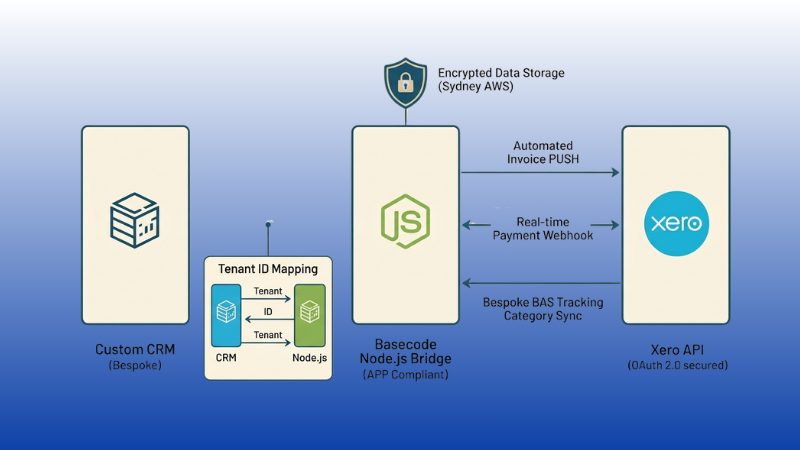
With the latest 2026 Privacy Act reforms, data sovereignty is no longer optional; it’s a legal necessity. For firms prioritising secure financial data storage in Australia, custom builds allow you to dictate exactly where your servers sit (e.g., AWS Sydney regions), ensuring full compliance with the Australian Privacy Principles (APP).
The Technical "Gotchas" We Solve (So You Don't Have To)
Building a high-performance bridge requires more than just calling an API; it requires a deep understanding of the Xero-Node SDK and modern security protocols.
The OAuth 2.0 & PKCE Handshake
In 2026, security is the foundation of any fintech application. Xero’s move to OAuth 2.0 & PKCE (Proof Key for Code Exchange) means your integration needs a robust authentication flow. We focus on building secure, encrypted token-management systems that keep your background syncs running 24/7.
Eliminating the “Duplicate Contact” Nightmare
We’ve all seen it: one customer ends up as three different entities in Xero because of a typo. Our solution focuses on eliminating duplicate contacts in Xero via API by using the Xero ContactID as the absolute Source of Truth. We implement “Fuzzy Matching” logic to check email addresses and ABNs before any data is pushed.
Real-Time Visibility via Webhooks
Stop “polling” the API, it’s inefficient and risks hitting API rate limits. We implement Webhooks so that the second a client pays an invoice in their bank feed, your CRM flips to “Paid” automatically. This provides your team with instant, real-time visibility into cash flow.

Is Your Integration "Fair and Reasonable"?
The latest updates to the Australian Privacy Principles (APP) have introduced a “Fair and Reasonable” test for data handling. When we architect a system at Basecode, we ensure:
- Data Minimisation: We only sync the essential financial data required.
- Immutable Audit Trails: Logs that show exactly when and why a transaction was synced.
- Enterprise-Grade Encryption: Utilising AES-256 to ensure your Xero tokens are locked tight.
Conclusion: Future-Proof Your Growth
A custom CRM is a powerful asset, but it’s only as good as its connection to your bottom line. By investing in a custom Xero integration for Node.js, you’re building a scalable engine ready for whatever the Australian economy throws at it next.
Looking for a Node.js developer for Xero integration in Sydney or Melbourne? Let’s build something that actually works for your unique workflow. At Basecode, we specialise in high-performance engineering for the Australian market.

FAQs
1. How to handle Xero API rate limits in Node.js?
We implement Exponential Backoff and Request Queuing. If you receive a 429 Too Many Requests response, our middleware automatically pauses, respects the Retry-After header, and resumes the sync without losing data.
2. Is Node.js secure enough for financial data sovereignty?
Absolutely. By using a custom backend, you have full control over the encryption layers and can ensure that sensitive financial data never leaves Australian borders, meeting the strict standards of the 2026 reforms.
3. What is the best way to sync Xero contacts without duplicates?
The best practice is to map your CRM’s internal ID to Xero’s GUID. Before any “Create” action, our system performs a “Lookup” by email or ABN to verify if the contact already exists.
4. Will a custom integration break when Xero updates its API?
Because we use the official Xero-Node SDK, your integration is built on a stable, supported foundation. We also implement “defensive coding” with automated alerts, so we are notified of any changes long before they impact your accounts.
5. Can I sync more than just invoices?
Yes. A custom bridge allows you to automate Purchase Orders, Expense Claims, Bank Feeds, and Payroll. Many of our clients automate contractor payments by linking their CRM’s project management module directly to Xero’s accounts payable, saving hours of manual admin every week.