The Software Is Working. So Why Is Your Business Still Struggling?
Table of Contents
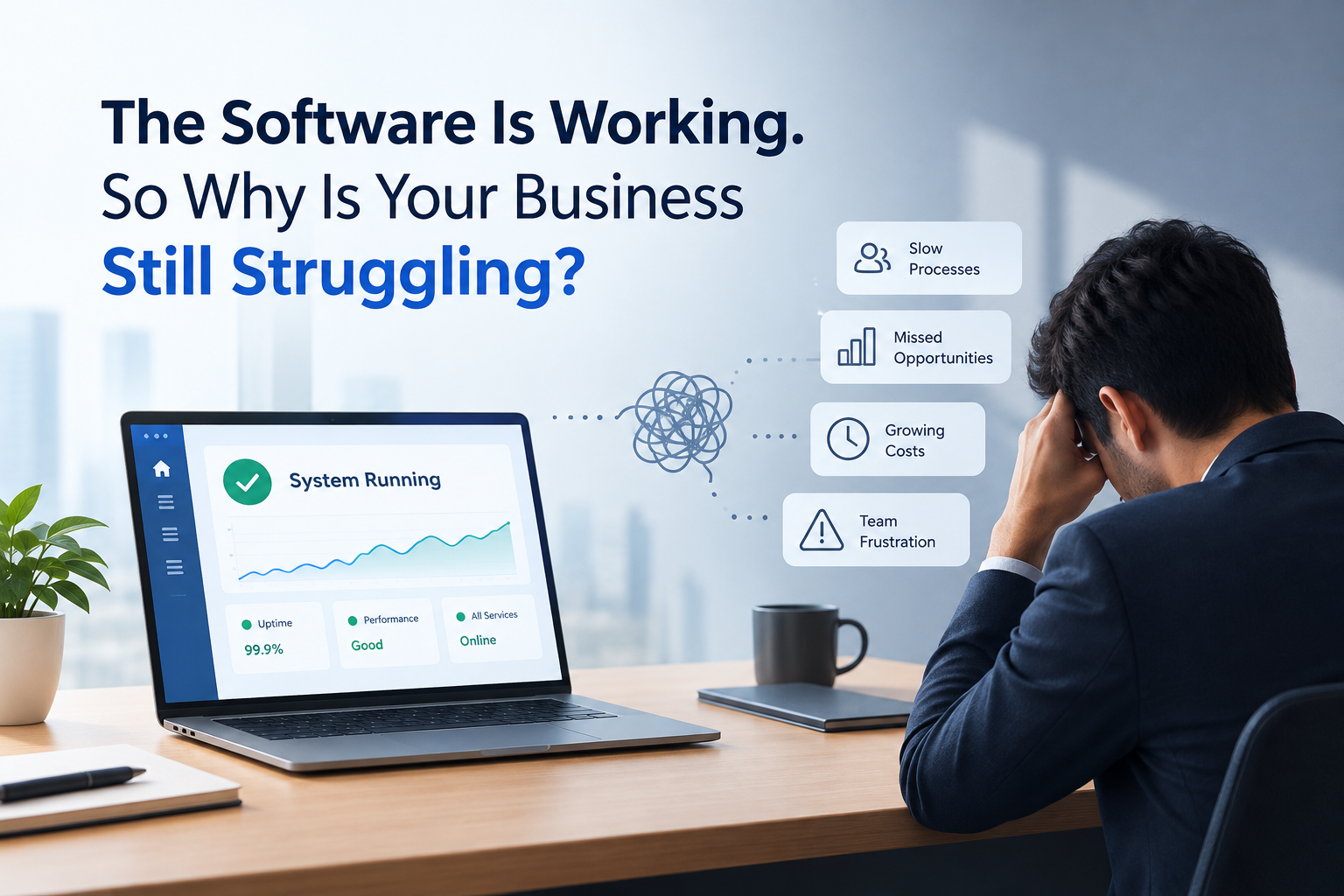
There’s a point where a business starts to realize that something isn’t quite right with its software.
Nothing is necessarily broken. The system opens when it should, employees can use it, customer information is stored, and reports can still be produced. But when existing software no longer fits the way a business operates, a custom software development service can provide a more suitable solution.
Yet simple tasks seem to take longer than they should.
Someone is updating a spreadsheet after entering the same information into another system. Another employee is copying data from one application to another. A manager is waiting for a report that takes hours to prepare. And whenever the business wants to change a process, the software seems to get in the way.
This is a common problem for growing businesses. The software may still work, but it may no longer work for the way the business operates today.
Your Business Has Changed. Has Your Software?
The software a business chooses when it has ten employees may not be the software it needs when it has fifty.
As a company grows, things naturally change. There are more customers to manage, more data to handle, more employees using different systems and more processes happening at the same time.
The problem is that the software often doesn’t change at the same pace.
A system that once made things easier can slowly become restrictive. Employees find their own solutions, and those solutions eventually become part of the daily routine.
You might notice your team:
- Keeping separate spreadsheets to track information.
- Entering the same details into different platforms
Downloading and uploading files between systems. - Creating manual reports because existing software doesn’t provide what they need.
- Using emails or messages to move information between departments.
- Finding workarounds whenever the usual process doesn’t fit
None of these problems may seem significant on their own. But add them together every working day, across an entire team, and the lost time starts to matter.
When Workarounds Become the Normal Way of Working
Hidden “Iceberg” Costs of Building In-House
The build quote you get rarely includes everything you’ll actually pay for.
- DevOps, QA testing, and architecture design. Someone has to test the software, deploy it safely, and design it so it doesn’t collapse under its own weight in year two.
- Ongoing bug fixes, maintenance, and security patches. Software isn’t a one-off purchase. It needs upkeep for as long as you use it, and that upkeep is a permanent line item, not a project cost.
Then there’s developer turnover. When the engineer who built your system leaves, someone else has to learn the codebase before they can safely touch it, and nobody puts that onboarding time in the original budget.
One of the easiest things to overlook is the amount of work people do around their software.
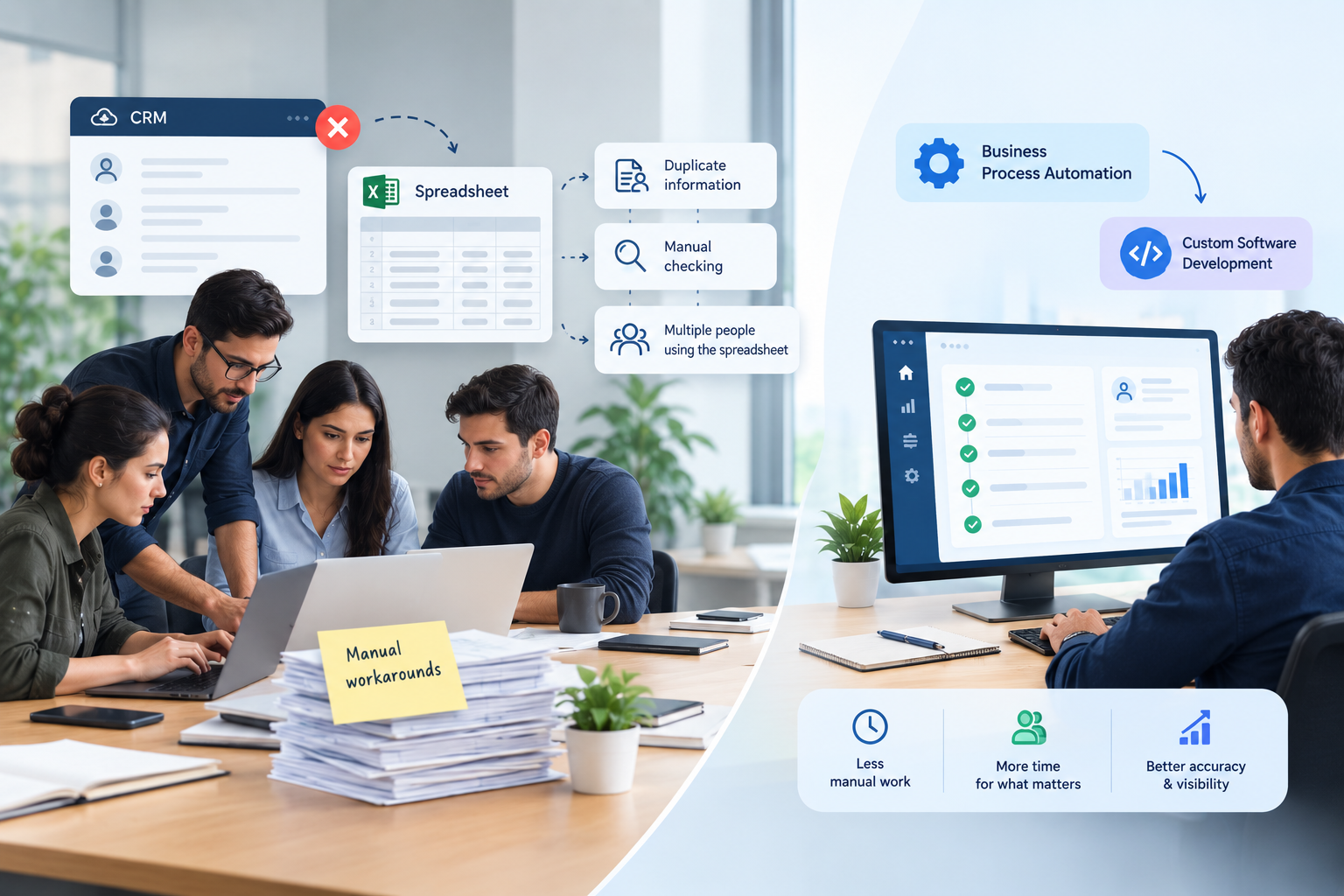
Imagine your CRM stores customer information, but it doesn’t handle one of your team’s important processes. Instead of changing the system, someone creates a spreadsheet.
At first, that’s fine.
Then more information gets added. Other employees start using the spreadsheet. Someone has to check whether it matches the CRM. Eventually, the business has two places storing information that should probably be in one.
The same thing happens with reporting, approvals, inventory, customer communication and other everyday processes.
This is where business process automation can help. Instead of asking employees to repeatedly complete predictable tasks, businesses can use technology to handle suitable parts of the process automatically. For businesses dealing with these limitations, a custom software development service can also help create software around their existing processes rather than forcing the team to adapt to another rigid system.
It isn’t about replacing people. It’s about taking unnecessary administration out of their day so they can spend more time on work that actually requires their expertise.
The Problem May Be Between Your Systems
Sometimes the individual software products aren’t the problem at all.
Your CRM works. Your accounting software works. Your internal systems work.
The frustration comes from having to use all of them together.
When systems don’t communicate properly, employees often end up acting as the connection between them. Information has to be copied, checked and entered again.
For example, a customer may update their details in one system while another team still has the old information in a different platform. Someone then has to notice the difference and fix it.
Multiply that by hundreds of customers and thousands of records, and it becomes a serious operational issue.
API integration and systems integration can help businesses connect the technology they already use. Rather than replacing every system, the goal can be to make those systems work together more effectively.
That can mean less repetitive data entry, fewer disconnected processes and better access to the information teams need.
More Software Isn't Always the Answer
When a business runs into a problem, buying another software subscription can seem like the easiest solution.
Sometimes it is.
But sometimes it just adds another layer to an already complicated setup.
You end up with another login, another database, another process for employees to learn and another system that needs to communicate with everything else.
Before adding another tool, it is worth stepping back and asking what is actually causing the problem.
Is the issue a missing feature? A lack of integration? A manual process? An outdated system? Or has the business simply outgrown the way its technology was originally set up?
The answer makes a difference.
The answer makes a difference.
Custom software development isn’t necessarily about throwing away everything you already have and starting again.
For some businesses, the better option is to build around the systems that are already working.
For example, your accounting platform may be perfectly suitable for your finance team, but you may need a custom application for another part of the business. That application could then connect with your existing systems through API integration.
Other businesses may need a bespoke CRM or ERP system because their processes don’t fit neatly into standard software.
A custom web application or cloud application could also make sense when employees or customers need a system built around a particular workflow.
Basecode takes this approach by building custom software around a business’s workflows, goals and future growth rather than forcing the business to adapt to a generic system. Its services include custom software development, bespoke CRM and ERP systems, customer portals, cloud applications and system integrations.
The important thing is not to start with the assumption that custom software is always the answer. Start with the business problem and work backwards from there.
Look at Where Your Team Is Losing Time
If you’re unsure whether your current software is holding the business back, look at what your employees actually do during a normal working day.
Ask them where they regularly lose time.
You may find that the biggest problems are surprisingly simple:
- Re-entering information.
- Searching across different systems
- Preparing reports manually
- Chasing approvals
- Checking and correcting data
- Moving information between applications
- Maintaining spreadsheets outside the main system
These are the areas worth investigating first.
In some cases, software optimisation or integration may solve the problem.
In others, automation or a new application may be the better option.This is also where technology consulting can be useful. Looking at the wider technology environment before deciding what to build can help prevent businesses from spending money on another solution that doesn’t address the real issue.
Software Should Support Growth, Not Get in the Way
The needs of a growing business won’t stay the same forever.
You may add new services, take on more customers, expand your team or introduce new systems. Your software needs to be able to accommodate those changes without making every adjustment unnecessarily difficult.
That doesn’t mean every business needs a completely bespoke technology platform.
It means your technology should be chosen and developed with the business’s actual requirements in mind.
The right solution might be an integration between two existing systems. It might be automating a time-consuming workflow. It might be modernising an older application. Or it might be developing a completely custom solution.
The starting point should always be the same: what is making the business harder to run than it needs to be?
The Software Works. But Is It Working for You?
That’s the question worth asking.
If your software does what it was originally designed to do but your business has changed significantly since then, the technology may simply have fallen behind.
You shouldn’t have to build your business processes around the limitations of your software. Your systems should help your people work efficiently, connect the information they need and give the business room to grow.
Basecode helps Australian businesses build technology around their actual requirements, from custom software development and API integration to web applications, cloud applications, systems integration and ongoing maintenance. The focus is on understanding the business first, identifying where the friction sits and then developing a practical solution around it.
Is Your Software Creating More Work Than It Should?
If your team is spending too much time on manual processes, working across disconnected systems or constantly finding ways around your existing software, it may be time to look at what’s underneath the problem.
Talk to Basecode about your software requirements and find out what a better-fit solution could look like.
Basecode offers a free consultation for Australian businesses looking to discuss their software challenges, workflows and technology goals.
FAQs
1.How do I know if my business has outgrown its software?
Frequent spreadsheet use, duplicate data entry, manual reporting, disconnected systems and recurring workarounds can all indicate that your current setup is no longer meeting the needs of your business.
2. Can I keep my existing software and add a custom solution?
In many cases, yes. A custom application can work alongside existing systems and connect with them through APIs or other integration methods. This can be more practical than replacing software that already works well.
3. Is custom software better than off-the-shelf software?
It depends on the business. Off-the-shelf software can be a good choice for common requirements. Custom software becomes more relevant when your workflows, integrations or business requirements don’t fit comfortably within standard products.
4. Can software integration reduce manual work?
It can. Connecting systems can reduce the need to repeatedly copy information between platforms. Depending on the processes involved, integration can also improve data consistency and make information available to the right teams more quickly.
5. What should I do before investing in new business software?
Start by identifying the actual problem. Speak to the people using the systems every day, identify processes that consume the most time and look at where information gets duplicated or lost between systems. Once you understand the problem, you can determine whether integration, automation, optimisation or custom software is the right solution.