
Local vs Offshore Software Development for Australian Businesses: The Honest 2026 Comparison
Table of Contents

You’ve run the numbers. A Melbourne-based custom software development team costs three to four times more than a team from Eastern Europe. On paper, offshore looks like a no-brainer.
But Australian businesses have been burned before with blown timelines, unusable code, and projects handed over to a local agency to fix at twice the original cost. So which model actually works? Here’s the comparison most vendors won’t give you.
What Australian businesses actually save going offshore and what they lose
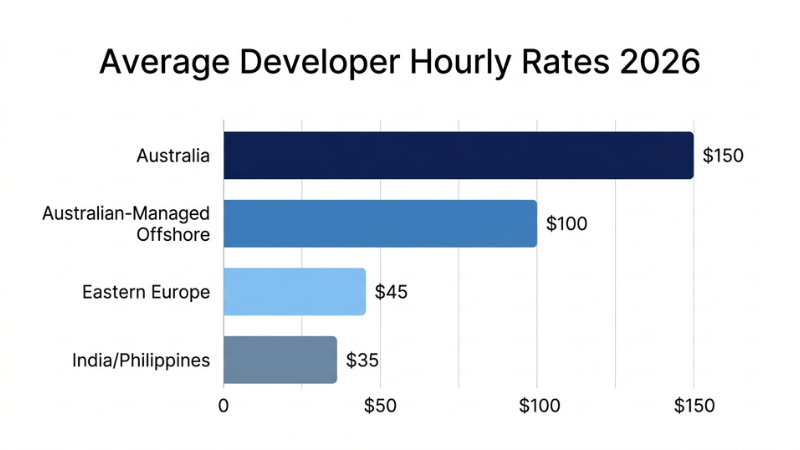
The headline saving is real. Senior custom software developers in Australia charge $120–$180 per hour. Equivalent talent in India or the Philippines runs $25–$50. For a six-month web application development project, that gap is easily $200,000.
That means you can fund a much bigger scope, launch faster, or protect margin. For startups in particular, that difference can determine whether a product gets built at all.
But the losses are real too:
- Rework costs: a 2023 Standish Group report found offshore IT projects had a 28% higher rate of major rework than onshore equivalents
- Integration tax: system-to-system integration work with Australian platforms (ATO, myGov, state health APIs) often requires local knowledge that offshore teams don’t have.
- Handover risk: if the relationship breaks down, getting your code, IP, and documentation out of an overseas firm is legally complicated
- Hidden management overhead: someone onshore usually ends up doing full-time project management, which adds cost back in
Action: Before comparing day rates, get a total-cost estimate that includes your internal time, potential rework, and handover provisions.
Timezone friction: why a 9-hour gap costs more than you think
Sydney to Mumbai is 4.5 hours. Sydney to Warsaw is 9–10 hours. For a custom app development project with daily decisions, that gap creates a feedback loop that stretches every sprint.
Here’s what that looks like in practice. You find a bug on Monday morning. You log it. Your offshore team picks it up Monday evening (their time). They push a fix Tuesday morning. You review it Wednesday, a two-day turnaround for something that should take two hours.
Async workflows help but only so far.
Good offshore teams manage this with async documentation, clear specs, and overlapping hours. Some Melbourne software development companies now build hybrid models with overlap windows. But the coordination cost never disappears entirely.
If your app development project involves ambiguous requirements, regulatory compliance, or fast-moving product decisions, timezone drag compounds the problem. If it’s a well-scoped build with stable requirements, it matters less.
Action: Map out the decision points in your project. If you’d need same-day answers more than twice a week, factor in the friction cost.
Legal protection: what happens when an offshore project goes wrong?
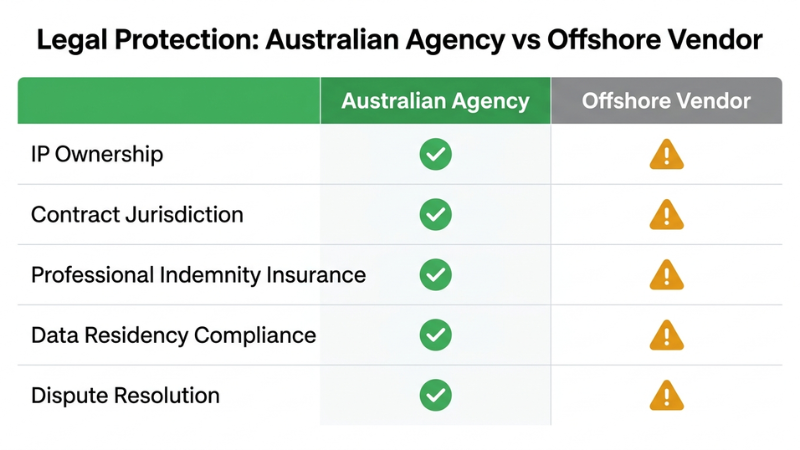
This is where Australian businesses get caught out. If you engage a web application development agency in Australia, you have clear remedies: Australian Consumer Law, contract enforcement in local courts, professional indemnity insurance requirements.
Offshore? It depends entirely on your contract. Most standard offshore agreements use the vendor’s local jurisdiction. Enforcing a contract in India or Eastern Europe through Australian courts is technically possible and practically difficult.
That means:
- IP ownership: ensure your contract explicitly assigns all IP to you, governed by Australian law
- Escrow: for any project over $100k, put source code in escrow with a third party
- Payment milestones: never pay more than 30% upfront; tie payments to working deliverables
- NDAs: ensure they’re enforceable in both jurisdictions, not just signed as a formality
If you’re building for healthcare, finance, or government sectors with strict data residency rules, work with a custom software development company that can demonstrate compliance with Australian frameworks from the start. See our guide to choosing a software development partner for the questions to ask.
Action: Get a local solicitor to review any offshore contract before you sign.
The middle path: Australian-managed offshore delivery
A number of Australian software agencies now run what’s sometimes called a ‘blended delivery’ model. An onshore team in Sydney, Melbourne, or Brisbane manages the project, holds the client relationship, and handles anything requiring local knowledge. The build itself runs through an offshore team the agency manages directly.
This model solves several problems at once:
- You get Australian legal protection and a local point of accountability
- Day rates sit somewhere between pure local and pure offshore, typically $80–$120 per hour
- IP, contracts, and compliance stay under Australian law
- Timezone management is handled by the agency, not by you
Basecode operates this way for clients where budget is a genuine constraint but quality and accountability are non-negotiable. The work spans mobile app development, web-based development, and systems integration, the kinds of projects where cutting corners on oversight creates real risk.
Action: Ask any Australian-managed offshore provider for references from clients who ran into problems mid-project. How they handled failure tells you more than how they sell success.
When local is worth paying more for
Not every project is a price optimisation problem. Some builds need local teams.
- Regulated industries: healthcare software, financial services platforms, and government applications often require demonstrable compliance with Australian frameworks. Offshore teams rarely have this by default.
- Tight feedback loops: if your product is evolving week to week based on user research, you need fast iteration. A co-located custom software development team in Melbourne or Sydney cuts decision latency significantly.
- Sensitive IP: if you’re building core business logic that would hand a competitor a real advantage, keeping the build onshore limits exposure.
- Integrations with Australian systems: ATO Single Touch Payroll, state health portals, PEXA these integrations are awkward for teams without local experience.
The cost premium for onshore custom software development in Australia is real. But so is the risk reduction. For some businesses, that trade-off is straightforward.
When offshore genuinely makes sense
Offshore software development is not inherently risky. Done well, it works. The projects where it works best share a few traits:
- Well-defined scope with stable requirements
- Non-regulated product (no healthcare, financial, or government compliance requirements)
- Experienced internal PM or technical lead who can run the relationship
- Tolerance for longer feedback cycles
- Budget that makes onshore genuinely unviable
Mobile app development services for a consumer product with clean specs, for example, can run well with an offshore team. So can front-end build work, QA, or back-end API development where the architecture is already designed.
The risk isn’t in the geography. It’s in hiring offshore for projects that needed a different model, usually because the price gap made it hard to say no.
Action: Before going offshore, run your project requirements past a local technical advisor. A one-hour paid consultation is a reasonable filter.
If you’re weighing up options for a custom software project in Australia, Basecode offers a free initial scoping call to help you identify the right delivery model for your budget and risk profile.

FAQs
1. Is it safe to hire offshore software developers in India or Eastern Europe?
Yes, with the right contracts and oversight. The risk isn’t the location; it’s loose specs, weak contracts, and no local escalation path. Offshore software development risks in Australia are mostly contractual and managerial, not technical.
2. What are the legal risks of hiring overseas developers in Australia?
The main risks are IP ownership disputes, difficulty enforcing contracts across jurisdictions, and data residency obligations. Use Australian-law contracts, assign IP explicitly, and check that data handling meets Australian Privacy Act requirements.
3. How do I protect my IP when working with an offshore team?
Use a contract governed by Australian law that explicitly assigns all code, documentation, and design to you. Add source code escrow for longer projects. Limit access to sensitive business logic until trust is established.
4. Does offshore development actually save money in the long run?
For well-scoped projects, yes. For complex, evolving builds, especially in regulated industries, total cost often matches or exceeds onshore once you add rework, management overhead, and remediation. The day rate comparison is rarely the full picture.
5. Is a hybrid software development model better than local or offshore?
For many Australian businesses, yes. A hybrid model combines local project management with offshore development, offering a balance of cost savings, quality control, and accountability.