
How Predictive Analytics in Finance Changes Business Decisions
Table of Contents
You have likely noticed that waiting for end-of-month accounts feels completely outdated. Relying on historical data to plan your next strategic move creates a dangerous operational lag. By the time your traditional spreadsheets flash red, the market has already moved ahead of you.
Forward-thinking leaders are shifting entirely away from reactive planning methods. They use data-driven financial decisions to outmanoeuvre competitors and control sudden operational costs. This deliberate shift relies heavily on predictive analytics in finance to turn historical data into actionable foresight.
Why Is Reactive Financial Planning Damaging Your Business?
Traditional accounting practices tell you exactly where your money went, not where it is going next. If you run a scaling enterprise or a fast-moving startup, blind spots will stall your growth.
Legacy data pipelines isolate your critical financial information in completely separate siloed systems. That means:
- Your cash flow forecasts miss sudden, aggressive market shifts.
- Your procurement teams consistently overpay for essential raw materials.
- Your growth capital stays locked up in unnecessarily large safety buffers.
Static spreadsheets simply cannot handle rapid economic fluctuations anymore. To fix this vulnerability, Australian enterprises are modernising their core backend systems. They implement real-time data streaming to capture every single transaction as it happens.
If your current software cannot process live data feeds, you need to upgrade your platform. Working with a dedicated web app development firm can help you bridge this technical gap. They build the robust data infrastructure required to feed modern analytics engines.
Takeaway: Stop reviewing old data and begin building a system that captures live financial events automatically.
How Do Predictive Financial Modeling Tools Minimise Operational Risk?
Risk mitigation is no longer about guessing the timing of the next market downturn. Modern businesses use predictive financial modeling to stress-test their daily operations against multiple economic scenarios.
These models use machine learning models to spot hidden anomalies in your supply chain and customer billing cycles. That means:
- You detect potential client defaults several weeks before they actually happen.
- You adjust your core pricing models automatically as inflation values shift.
- You allocate internal capital across departments with mathematical certainty.
Implementing these advanced tools requires robust system to system integration. Your accounting software, CRM, and inventory databases must speak the same language flawlessly.
Many businesses fail here because their legacy software cannot connect to modern APIs. If your internal systems remain isolated, you cannot leverage AI-driven financial forecasting. You can resolve this bottleneck by hiring expert custom software developers to build secure, automated data pipelines.
Before you deploy these models, you must ensure your data is clean and consolidated. Read our comprehensive guide on why data integration is the mandatory first step before adopting AI to prepare your infrastructure properly.
Takeaway: Replace manual risk assessments with automated financial models that update every single hour.
What Does AI-Driven Financial Forecasting Mean for Your Cash Flow?
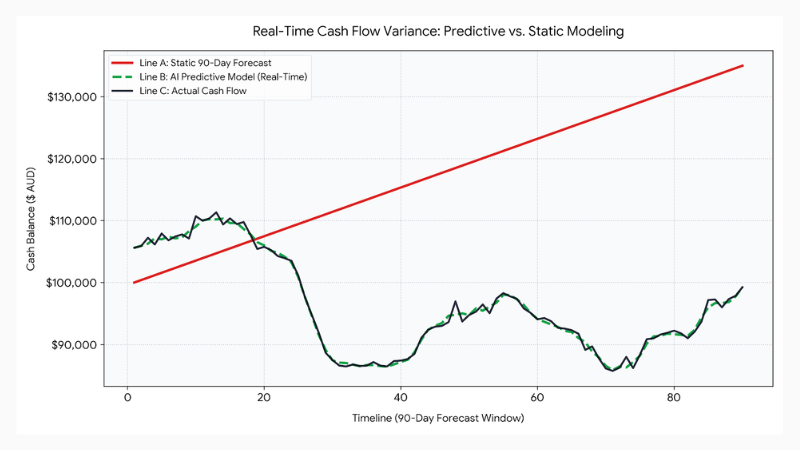
Sudden cash flow issues sink highly profitable businesses every day. Advanced analytics changes this dynamic completely by removing guesswork from your working capital management.
Advanced forecasting tools analyse seasonal trends, historic payment behaviors, and macroeconomic data simultaneously. That means:
- Your cash flow forecasting becomes highly accurate down to the specific day.
- Your inventory levels match exact customer demand patterns without excess storage.
- Your business eliminates the need for expensive, short-term emergency loans.
These tools leverage cloud scalability to process massive datasets without slowing down your daily operations. You get clear, visual dashboards that show your exact cash position three months from today.
To get these insights, you need tailored software that fits your specific workflow perfectly. Partnering with a reliable custom software development company ensures your forecasting tools match your internal business logic. For businesses based in Victoria, collaborating with a local team specialising in custom software development Melbourne can speed up your overall deployment time.
Takeaway: Deploy automated cash flow forecasting tools to identify and patch capital shortfalls before they impact operations.
How Can Custom Software Unlock Better Financial Insights?
Off-the-shelf financial software often forces your team to change established business processes to fit a rigid system structure. Custom software application development solves this issue by tailoring the technology to your exact operational needs.
Custom solutions allow you to integrate secure API integrations that pull data from proprietary sources. That means:
- You view unified financial metrics on a single, clean user interface.
- You automate manual data entry tasks across multiple separate departments.
- You scale your software infrastructure without paying costly per-user license fees.
Some enterprises even deploy custom LLMs to query their internal financial data using natural language. This allows busy executives to get instant answers without waiting for data analysts to build custom reports.
If your team spends hours copying data between applications, your current software is failing your business. Investing in tailored app development services will streamline your operations and secure your data pipelines. Professional application developers can transform your messy spreadsheets into a secure, proprietary corporate asset.
Once your core financial data is integrated, you can expand AI automation into other business areas. Discover how modern businesses are using generative AI to optimise internal business reporting to save hours of manual labor.
Takeaway: Audit your current financial software setup and replace generic tools with custom systems built for your data structure.
Let’s discuss how to integrate predictive tools into your current financial systems. Explore our custom software development services to modernise your data infrastructure.

FAQs
1. Will predictive analytics completely replace my financial controller?
No, it enhances their operational capabilities. The software automates data aggregation and trend analysis, which allows your controller to focus heavily on high-level strategic decisions.
2. How much historical data do we need to start predictive modeling?
You generally need 12 to 24 months of clean, consistent financial records. Machine learning models require this specific baseline data to identify accurate seasonal trends and cyclical patterns.
3. Can small businesses benefit from predictive analytics in finance?
Yes. Cloud-based tools have made predictive analytics accessible well beyond enterprise budgets. Even small businesses can deploy affordable forecasting software to manage cash flow, reduce late payments, and plan inventory more accurately without hiring a dedicated data team.
4.Is cloud-based financial forecasting secure for sensitive corporate data?
Yes, provided you use enterprise-grade encryption and secure API integrations. Modern custom business software uses the exact same security protocols as tier-one banking institutions.
5. How long does it take to see a return on investment from financial analytics?
Most companies see measurable cost reductions within six months of deployment. The return comes directly from optimised inventory, reduced bad debt, and faster cash collection cycles.