
Why Data Integration Is the Mandatory First Step Before Adopting AI
Table of Contents

You’ve watched the AI conversation explode. You’ve sat in meetings where someone says “we need to add AI” and heads nod around the table. But something feels off like you’re being asked to decorate a room before the walls are up.
That feeling is correct.
Before AI can do anything useful for your business, your data needs to be in order. Not just stored. Not just collected. Integrated. Most businesses skip this part. That’s why so many AI projects go quiet after the first few months and why the money spent on them rarely comes back.
What Data Integration for AI Actually Means
Data integration for AI means pulling all your data sources into one clean, consistent, unified layer, the kind that’s actually AI-ready data. Your CRM. Your finance system. Your website analytics. Your support tickets. Right now, these almost certainly live in separate tools, in different formats, with different field names.
That’s a problem AI cannot fix for you.
AI models learn from data. Feed them broken, disconnected data and you get broken, unreliable outputs. No amount of clever tooling changes that.
That means:
- Decisions powered by AI reflect whatever gaps exist in your data
- Automated processes built on poor data inherit every error
- Any AI tool you buy is sitting on top of a problem it can’t even see
Why AI Readiness for Business Starts With Your Data Stack
Most businesses buy AI tools expecting them to sort out their data problems. It doesn’t work that way.
AI readiness for business isn’t about which tool you pick, it’s about whether your underlying data can hold up. AI needs a solid base to work from. Without it, you’re not deploying AI. You’re deploying expensive confusion.
Here’s what that actually looks like day-to-day:
- Data silos mean your sales and finance teams work from different versions of the same numbers
- Customer data lives in your CRM but doesn’t connect to your billing system
- Your operations team exports spreadsheets manually every Monday morning
- Different departments use different names for the same metric
None of this is small stuff. Each issue is a hard ceiling on what AI can do for you. And it’s far more common than most businesses let on 68% of organisations rank data silos as their single biggest data challenge.

How Poor Data Causes AI Projects to Fail
This is where businesses lose money.
A company puts a budget into a predictive analytics platform. The tool is solid. The vendor knows what they’re doing. But three months in, the outputs are off often enough that nobody trusts them. The project loses momentum. The tool gets written off. What actually happened? The data feeding it was never unified. If you want to see how predictive tools perform when data is in order, see how predictive analytics changes financial business decisions.
The same thing happens with automation. A business tries to automate manual workflows with AI-driven software. It breaks because it can’t reconcile two different customer ID formats across systems. That’s a data integration problem dressed up as a technology problem. We go deeper on this when automating manual workflows with AI-driven software in specific industries.
Sound familiar? Here’s what keeps happening:
- AI surfaces insights your data structure doesn’t support
- Automation breaks at exactly the point where two data sources can’t speak to each other
- Reporting tools produce contradictory numbers from the same business
- Poor data governance means no one knows which dataset to actually trust
What Proper Data Integration Unlocks
Sort this out and the rest actually works.
When your data is integrated, AI does what it’s supposed to. Generative AI tools including those built on retrieval-augmented generation (RAG) need clean, connected data to produce outputs worth acting on. Your customer service team can work from full, accurate interaction histories, the kind that makes custom AI development for better customer service experiences genuinely useful. Your leadership team gets reports that write themselves, not ones someone spent Tuesday afternoon compiling which is exactly what using generative AI to optimise internal business reporting is built on.
A solid data integration foundation also means:
- AI deploys faster, because the groundwork is already there
- Outputs are more accurate, because models train on clean, consistent inputs
- Costs come down, because you stop paying to fix data after every AI run
- Compliance gets easier, because you know where your data lives and who touches it
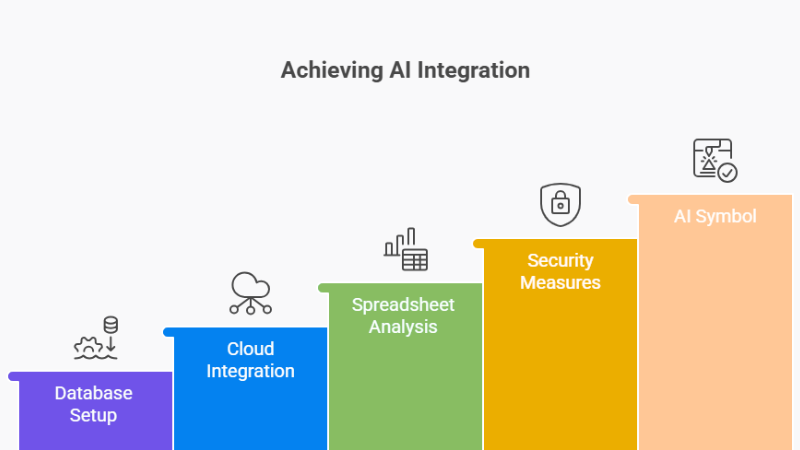
How to Approach Data Integration Before You Buy Any AI Tool
Start with an audit. Map every system that holds business data. For each one, work through four questions:
- Can this system export data in a standard format?
- Does this data share common identifiers with other systems?
- Who owns this data, and can it actually be used for AI processing?
- Is there a data governance policy covering how this data is stored and accessed?
From there, it’s about priorities. You don’t need to connect everything at once. Start with the data streams that feed your highest-value decisions: customer behaviour, revenue performance, operational throughput.
Choose an integration method that matches your scale. A data warehouse works for some businesses. Others need a customer data platform or a purpose-built data pipeline using ETL tools. The tool you pick matters less than the habits you build around it: consistent schemas, clear ownership, regular data quality checks.
Before you buy any AI product, ask the vendor one question: “What data format and quality does this require to perform as advertised?” Their answer will tell you exactly where your integration work needs to get to.
If you want AI to deliver real results, the first conversation to have is about your data, not your AI vendor shortlist.

FAQs
1. Won't the AI tool sort out our messy data anyway?
No. It’ll just produce messy results faster. Sort that out first.
2. We're a small team, is this really worth the effort?
The smaller you are, the faster you can do it. You’ve got fewer systems. Start now while it’s still straightforward.
3. How long does this actually take?
Anywhere from a few weeks to a few months depends on how many tools you’re running and how siloed they are. An audit on day one tells you where you stand.
4. We've already bought an AI tool. Is it too late?
No. Stop, map your data, then move forward. Most platforms have a setup phase that uses that window properly rather than pushing through with broken inputs.
5. Do we have to redo this every time we add a new tool?
Not redo, just maintenance. Every new tool needs to connect cleanly to what already exists. Build that habit early and it stays manageable.