
The MVP is Dead: Why Australian Founders are Shifting to ‘Minimum Lovable Products’ (MLP)
Table of Contents
If you spend any time in the tech communities of Sydney or Melbourne right now, you’ll notice a clear trend: the old rules of starting a software company have changed. For over a decade, the Minimum Viable Product (MVP) was the standard method for startups. It was the basic, functional version of an idea built quickly to see if it could work. The common advice was: “If you aren’t embarrassed by your first version, you launched too late.”
Fast forward to 2026, and that advice is actually quite risky.
In today’s Australian market, launching a product that makes you feel “embarrassed” isn’t a badge of honour, it is a major competitive disadvantage. The market is crowded. Between AI-generated tools and global companies entering the Australian market, being “functional” is no longer enough to stand out. It is just the basic requirement. This is why the successful founders we work with at Basecode are moving away from the MVP in favour of the Minimum Lovable Product (MLP).
The Reality Check: Why ‘Functional’ Isn't Enough Anymore
The MVP was created in a time when simply making something work online was difficult. Back then, if you built a tool that successfully moved data from one place to another, users would tolerate a poor design and a slow experience because they had no other choice.
But the world has moved on. In 2026, thanks to the explosion of advanced development tools and AI, building “functional” software is simple. It has become a commodity. Almost anyone with a laptop can launch a basic app over a weekend.
For an Australian founder, launching a basic MVP today is like opening a cafe that serves “average” coffee. In cities like Melbourne or Sydney, where standards are high, you will struggle to find a customer base. People do not want products that simply work; they want products they actually enjoy using.
What Exactly is a Minimum Lovable Product?
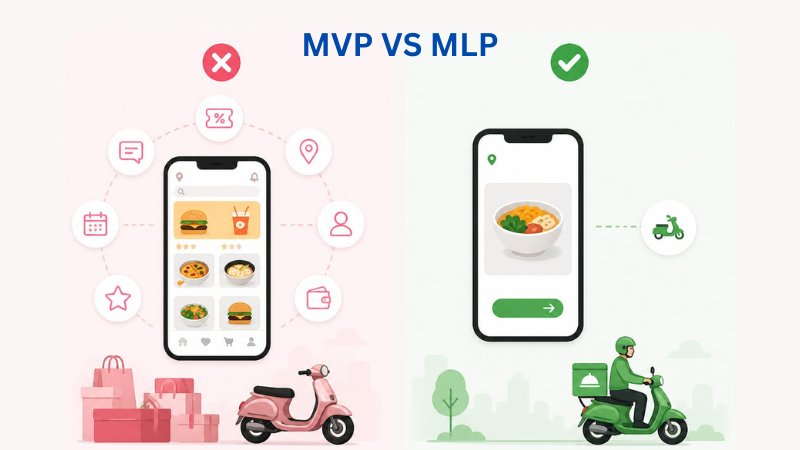
An MLP is not just an MVP with a better logo. It is a complete shift in your strategy.
While the MVP asks, “What is the absolute least we can do to solve the problem?”, the MLP asks, “What is the smallest version of this idea that will make a user truly enjoy the experience?”
It focuses on three core areas:
- Utility: It solves the actual problem (the basic requirement).
- Reliability: It is stable. There are no error screens when a user is trying to complete a task.
Delight: It feels intuitive. It is fast, easy to navigate, and respects the user’s time.
The Strategic Edge: Why Founders are Making the Switch
1. Retention is the Key Metric
In the current Sydney investment landscape, venture capitalists are no longer impressed by total download numbers. They care about how many people keep using the app. MVPs often lose users quickly because the experience is frustrating. An MLP creates a “buffer” against competition through high retention. When a user loves how an app feels and flows, they are much less likely to look for an alternative.
2. The Trust Factor in 2026
Trust is hard to earn today. With the 2026 Australian Privacy Act reforms now in effect, Australian users are very careful with their personal information. A product that looks “unprofessional” or “cheap” does not just look low-budget; it looks unsafe. A polished, well-designed MLP signals that you are a professional business that takes data security seriously. By investing in quality early, you actually lower your marketing costs because trust is built directly into the user interface.
How to Build an MLP Without a Massive Budget
You do not need a massive budget to build an MLP. You just need to be more selective about what you build.
Step 1: Focus on Your ‘Core’ Feature
Do not try to build a platform that does everything at once. Identify the single feature that provides the most value the reason you started the company and make that experience excellent. Your “Settings” page can be simple, but your main dashboard needs to be high-quality.
Step 2: Speed is a Feature
In Australia, users access apps from high-speed 5G in the city to slower connections in regional areas. Nothing ruins a user’s experience faster than a loading icon. At Basecode, we believe that speed is a deliberate design choice. If your app is incredibly fast, users will overlook a lack of extra features. If it is slow, they won’t care how many features it has.
Step 3: Local Understanding
This is where working with a local team is helpful. An MLP for the Australian market needs to feel relevant to local users. This means understanding our specific compliance rules, our professional standards, and our industry requirements. You cannot get that from a generic, one-size-fits-all template from overseas.
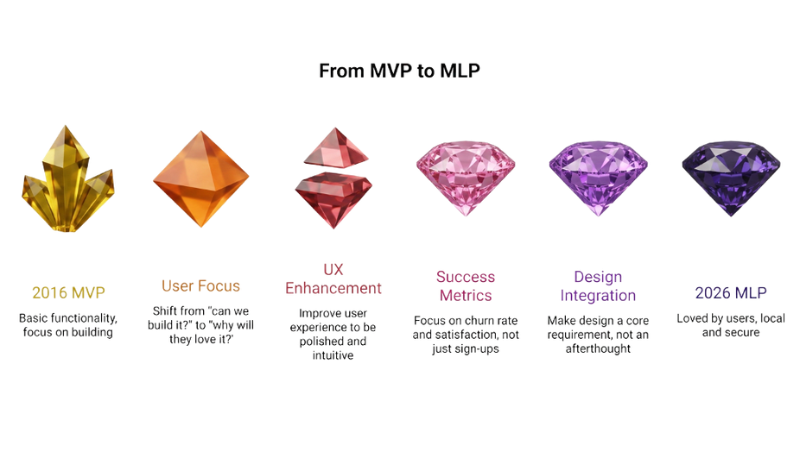
The Comparison: 2016 vs. 2026
Feature | The 2016 MVP | The 2026 MLP |
Focus | “Can we build it?” | “Why will they love it?” |
User Experience | Basic / Functional | Polished / Intuitive |
Success Metric | Number of Sign-ups | Churn Rate & Satisfaction |
Design | A secondary thought | A core requirement |
Hosting | Cheapest option | Local & Secure |
The Verdict: Do Not Just Launch, Connect
The MVP approach has not disappeared, but the standards have been raised. In 2026, being “viable” is the starting point, not the goal.
If you want to build a software company that survives its first year in the Australian market, you have to aim for a deeper connection with your users. Stop building basic prototypes and start building products that people actually look forward to using every day.
Ready to move beyond “viable”?
FAQs
1. Does an MLP take longer to build?
Not necessarily. Because you are removing unnecessary features to focus on making the core features perfect, the timeline is often similar to an MVP. The focus shifts from the number of features to the quality of the code.
2. What if my competitors have more features than my MLP?
Users usually prefer a simple tool that works perfectly over a complex tool that is confusing or slow. In 2026, quality consistently beats quantity.
3. How do I know if my product is "lovable"?
Check your organic growth. If people are recommending your app to their colleagues without you paying for an advertisement, you have achieved the MLP standard.
4. Can Basecode help me improve my current MVP?
Yes. We frequently take existing functional products and modernise them, improving the design, fixing technical issues, and turning them into products that users genuinely enjoy using.
5. Why is "Sovereignty" important for an MLP?
In Australia, data residency is now a major selling point. Telling your users that their data is stored locally and complies with the 2026 Privacy Act is a feature that builds significant user loyalty.