
Why Custom Software Development ROI Outperforms SaaS Subscriptions Long-Term
Table of Contents
Almost every business kicks things off with SaaS tools. Makes sense, right? Low barrier to entry, nothing complicated to set up, and you’re not committing to some massive financial decision before you’ve even figured out what you actually need.
Then you start growing and the cracks show up.
Suddenly the tools that made life easier are the ones slowing you down. Costs you didn’t plan for. Workflows that feel like square pegs in round holes. And somewhere in the middle of all that, the question surfaces:
Is custom software development ROI actually better than sticking with SaaS long-term?
Let’s get into it honestly.
The "Per-User" Trap: Why SaaS Costs Keep Rising
On the surface, SaaS pricing feels manageable. Pay per user, pay per month. You know what you’re getting.
Until you hire more people.
Every new team member has another license. Another line on the invoice. Scale your team from 10 to 50 people and suddenly you’re not just paying more you’re paying a lot more, for the exact same product. That’s the SaaS scalability problem nobody really warns you about upfront.
So when people ask, is custom software actually cheaper than SaaS in the long run? The real answer is: it depends on where you’re standing on the timeline.
Early on? SaaS wins, no contest. But months turn into years, and those monthly charges don’t stop. Custom software costs more at the start, yes. But once it’s built, adding users doesn’t really change your costs. That shift is where the long-term ROI starts to tell a different story.
Operational Efficiency: Custom Software vs SaaS Workflows
SaaS tools are built to work for as many businesses as possible, which is exactly why they don’t work perfectly for any specific one.
The gaps show up in small ways at first. A little manual data entry here. Copying something from one tool into another there. Workarounds that feel temporary but somehow become permanent. Over time, those small friction points add up to real hours and real money.
SaaS (Generic Workflow) | Custom Software (Automated Workflow) |
Multiple disconnected tools | One unified system |
Manual data entry | Automated data syncing |
Repetitive processes | Streamlined workflow automation |
Limited flexibility | Tailored business logic |
Frequent workarounds | Built for your exact needs |
If this is starting to sound familiar, you might be wondering, how do I actually know if my business has outgrown SaaS?
The honest answer is you probably don’t need a checklist to figure it out. You feel it. Five tools that don’t talk to each other. Someone on your team spending half their morning on something that should take ten minutes. Bills creeping up every quarter. Processes nobody can actually justify, except that’s just how the software works so everyone stopped questioning it.
When the software is calling the shots and your team is just working around it, that’s your answer.
Strategic Value: Owning vs Renting Software
Strip away the dashboards and feature lists and SaaS is, at its core, a rental agreement.
You pay every month. You get access. You stop paying, you lose access. There’s no equity in it, no assets being built, nothing that compounds over time. Just an ongoing cost.
A lot of business owners assume custom software is only something the big players invest in but that’s an outdated idea. Plenty of mid-sized, growing companies are making this shift now. The deciding factor isn’t how big you are. It’s how critical your internal processes are to your competitive edge.
If your workflows are genuinely what separates you from competitors, renting a generic tool to run them starts looking a lot less sensible.

The Hidden Costs of SaaS Subscriptions
The monthly subscription is just the visible part of the bill.
Integration Overload
Most growing businesses don’t use one SaaS tool; they use five, six, maybe more. And getting those tools to actually work together? That’s where the real headache lives. Teams jump between platforms constantly, context gets lost, and the day quietly fills up with coordination that shouldn’t be necessary.
What are the biggest hidden costs of SaaS? Usually it looks like this:
- Hours burned switching between tools
- Paying for feature sets that 80% of your team never touches
- Manual data entry filling in the gaps between systems
- Errors that creep in when things don’t sync properly
Feature Bloat
SaaS platforms are built to appeal to the widest possible customer base, so they pack in features. Most of which you’ll never use. You’re still paying for them though.
Data Silos
Disconnected tools mean disconnected data. Someone ends up doing the bridging manually pulling a report here, copy-pasting it there and decisions get made on information that’s already a few steps behind.
Vendor Lock-In and Risk Factors
SaaS Vendor Lock-In
Here’s the part that doesn’t get enough attention: when you rely heavily on a SaaS platform, you hand over a surprising amount of control.
The vendor raises prices. Changes a feature your team depends on. Gets acquired. Shuts down a plan tier. You find out when the email arrives and then you scramble.
What is SaaS vendor lock-in, and why does it matter? Because your operations are partially in someone else’s hands. Decisions that affect your business are being made by people whose priorities have nothing to do with yours.
Data Control and Security
When your data lives in a SaaS platform, it lives on their servers, under their terms. With custom software, that changes entirely, you control who accesses what, how it’s stored, and how it’s protected. For businesses in regulated industries or those handling sensitive client data, that’s not a small distinction.
How to Calculate Custom Software ROI for Your Business
If you’re trying to figure out whether the numbers actually work for your situation, start here:
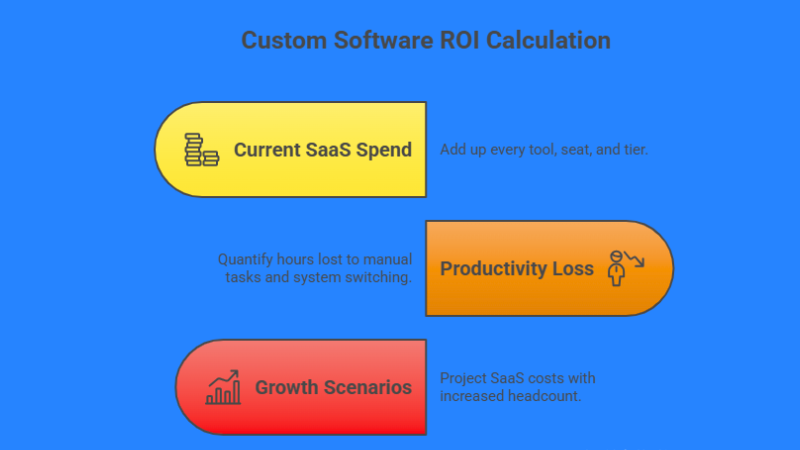
- Add Up Your Current SaaS Spend
Every tool, every seat, every tier. Most businesses are surprised by the total.
- Put a Number on Productivity Loss
How many hours per week are going toward manual tasks, switching between systems, fixing errors from disconnected tools? Multiply that by your average employee cost. The number tends to be uncomfortable.
- Think Through Growth Scenarios
What does your SaaS bill look like when you double headcount? Because the answer is usually: twice as much, for the same functionality.
Breakeven Analysis
How long before custom software pays for itself?
Most businesses hit that point somewhere between 18 and 24 months. Past that, you’re not just saving money, you’re running a more efficient operation than the one that was paying monthly for tools that kind of fit.
When Should You Move from SaaS to Custom Software?
When the tools you’re using are creating more problems than they’re solving. When growth is being held back by software that wasn’t designed with your business in mind.
Specific signs worth paying attention to:
- Operations getting more tangled as you scale
- SaaS costs that grow faster than your revenue
- Integration issues that never quite get resolved
- Inefficiencies showing up in team performance metrics
At that stage, building custom software isn’t a luxury spend, it’s the move that lets you keep growing without the ceiling.
Final Thought
There’s nothing wrong with starting on SaaS. Most successful businesses did.
But there’s a point where renting tools built for everyone stops being practical for a business that’s figured out what makes it different. Growth at a certain stage needs infrastructure. You actually own systems that reflect how you work, not how some average company works.
When your processes become your advantage, it’s worth building something that protects them.

FAQs
1. When should I ditch SaaS for custom software?
When your team is working around the software instead of with it. Spreadsheet bridges between tools, processes that never quite fit, those are signs you’ve outgrown off-the-shelf.
2. Is custom software actually more cost-effective?
Long term, yes. SaaS bills never stop, and they grow every time you hire. Custom software costs more upfront, but once it’s built, adding users costs you almost nothing.
3. What are the hidden costs of SaaS?
Rarely just the monthly subscription. The real drain is time toggling between apps, fixing sync errors, upgrading to a pricier tier just to unlock one feature you actually need.
4. What is vendor lock-in?
It’s when a provider can raise prices or cut a feature you depend on, and you have no real options. With custom software, those decisions stay yours.
5. How do I calculate ROI?
Add up your yearly subscriptions plus the hours lost to manual workarounds. If that number beats the cost of building something tailored over 18–24 months, the case is pretty straightforward.